 Brett Lindenberg

Formative assessment online tools check what learners understand while learning is still under way, so you can reteach or let them try again before the test or the job. They fall into four groups. Live quiz and game tools run checks during a session you lead: Kahoot!, Wayground (formerly Quizizz), Socrative, Gimkit, and Blooket. Lesson and slide platforms put checks between pieces of content: Nearpod, Pear Deck, and Formative. Video tools ask questions inside a video: Edpuzzle and Mindstamp. Google Forms and Microsoft Forms handle quick self-graded checks. Most of these products are built and priced for schools. For workplace training, start with Kahoot! 360, Wayground for Business, the two form builders, or Mindstamp.
What makes an online tool good for formative assessment
A formative check helps only when someone acts on the result. In their 1998 review of classroom research, Black and Wiliam reported firm evidence that strengthening the frequent feedback learners receive about their learning produces substantial learning gains (Assessment in Education, 1998). Answering questions also helps by itself. Roediger and Karpicke found that students who took recall tests remembered more two days and one week later than students who restudied the same text (Psychological Science, 2006).
Judge each tool by how well it closes that loop. Look for:
- feedback the learner sees right after answering, with an explanation for each choice where possible
- a live or per-question view that shows you which idea the group missed
- a way to act inside the tool, such as a retry, a follow-up question, or a route back to the explanation
- settings that keep the stakes low, such as turning off timers and leaderboards
- reports you can read in a few minutes, by question as well as by person
Our guides to what formative assessment is and formative assessment techniques cover the teaching methods behind these tools.
12 formative assessment tools at a glance
Free options differ most in what they leave out for formative use, such as question-level reports, live views, and player limits. Our list of online assessment tools for teachers has the full classroom prices.
| Tool | Formative job | What the free option leaves out | Fit for workplace training |
|---|---|---|---|
| Kahoot! | Live review games and self-paced kahoots | Kahoot! Go hosts up to 40 players | Yes, with Kahoot! 360 plans |
| Wayground | One question set as a live game, homework, or test | Free for teachers; schools buy by quote | Yes, with Wayground for Business |
| Socrative | Live polls, exit tickets, and quizzes | 1 room, 5 quizzes, 50 students per activity | Possible; Socrative lists corporate users |
| Gimkit | Strategy games built on a question set | About 3 rotating game modes and no homework assignments | Built for classrooms |
| Blooket | Arcade-style review games, live or as homework | 60 players, 14-day homework limit, no question-by-question reports | Built for classrooms |
| Nearpod | Activities between slides and inside video | 40 student joins per lesson; no Draw It, Time to Climb, or advanced reports | Built mainly for K-12 |
| Pear Deck | Questions inside presentation slides | Teacher Dashboard with names, plus drawing and draggable answers | Built for K-12 |
| Formative | Live view of every answer as learners work | 6 question types, 14 days of tracker history, no rubrics or time limits | Built for K-12 |
| Edpuzzle | Questions inside video, with skipping blocked | 20 interactive activities | Built for teachers |
| Mindstamp (our product) | Questions inside training video, with retries and routes back to the lesson | No free plan; 14-day free trial with no payment card | Yes |
| Google Forms | Self-graded quizzes with answer feedback | Included in Google Workspace; personal Google accounts can also use it | Yes |
| Microsoft Forms | Self-graded quizzes and a practice mode | Included in Microsoft 365 business and education plans; personal Microsoft accounts can also use it | Yes |
Tools for live checks during a session
Use these when you lead the session, in a room or on a video call, and want to see the whole group's answers before you move on.
Kahoot!
Kahoot! shows questions on a shared screen while learners answer on their phones. In a standard live game, a correct answer earns fewer points the longer a player takes, which rewards speed over thought. For a formative check, turn on accuracy mode, which scores correctness only, or assign the kahoot self-paced with the timer off. A confidence option asks each player how sure they are after answering, which helps you spot confident wrong answers (Kahoot! Help Center). The free Kahoot! Go plan for schools hosts up to 40 players.
Wayground (formerly Quizizz)
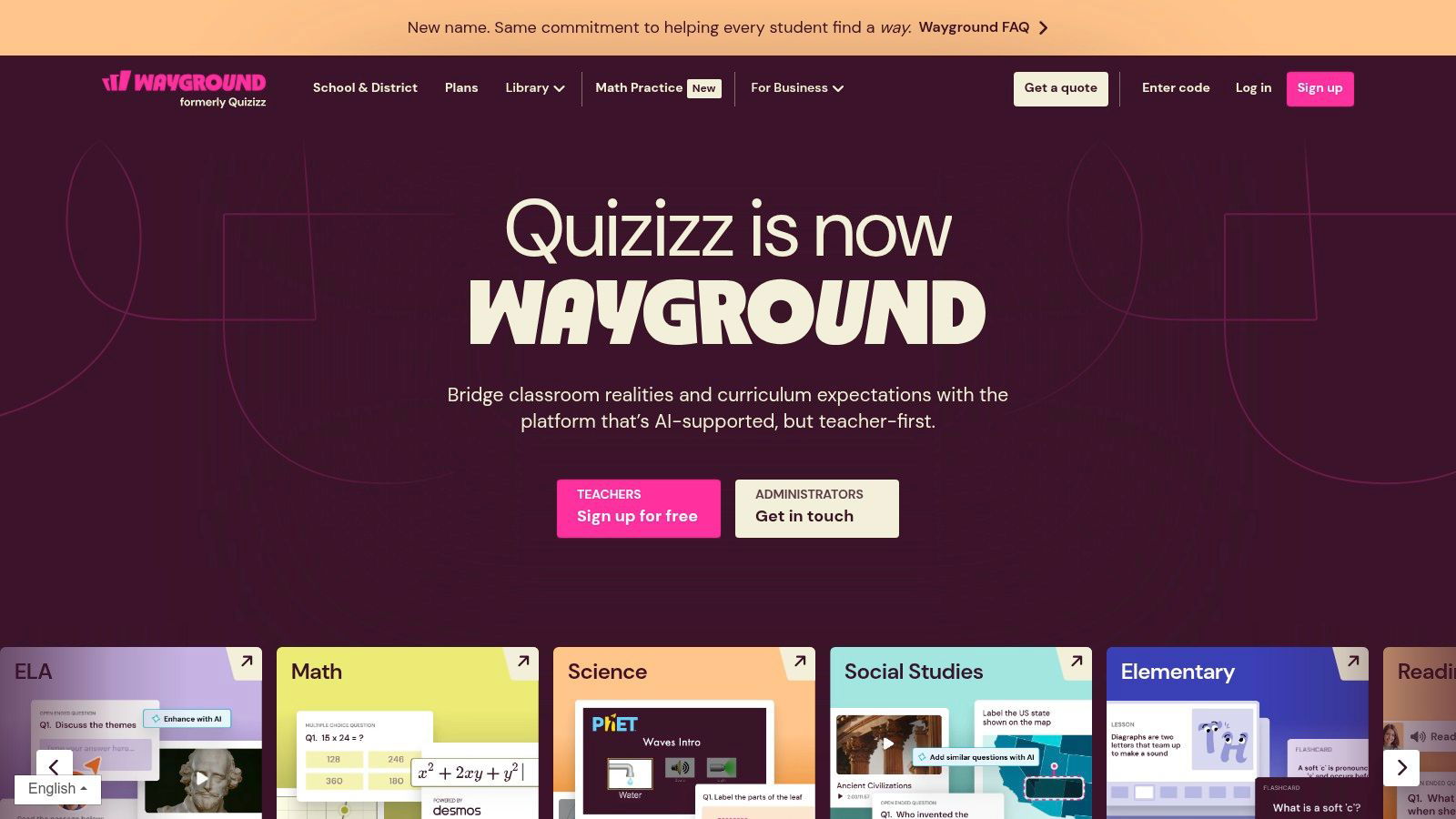
Quizizz now operates as Wayground, and quizizz.com redirects to the new site. One question set can run as a live game, as auto-graded homework that shows you what learners missed before class, or as a formal test. It includes more than 25 built-in accommodations, such as read-aloud and translation, and AI tools that build an activity from a topic or a document.
Socrative
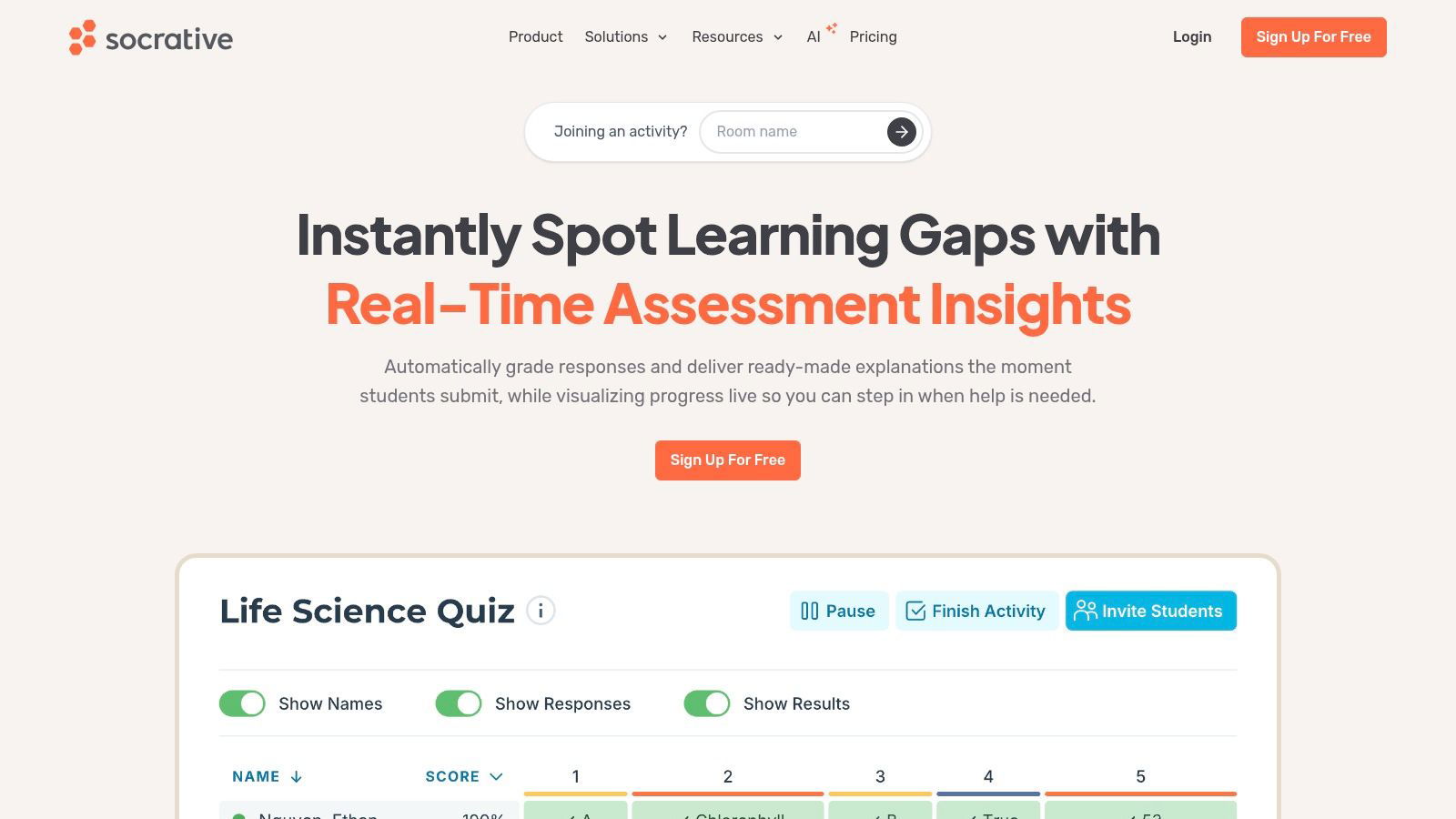
Socrative, a Showbie product, grades responses as learners submit them and shows ready-made explanations right away, while you watch results fill in a live table. Live polls and exit tickets suit a one-question check at the end of a topic, and Space Race turns a quiz into a team race. The free plan covers 1 room, 5 quizzes, and 50 students per activity, and Essentials costs $120 a year for 5 rooms and unlimited quizzes (Socrative plans, checked October 2026). Socrative lists corporate and vocational education among its audiences.
Gimkit
Gimkit turns a question set, called a kit, into a live game. In many modes, players answer questions to earn energy or move ahead in a 2D world. The free Basic plan allows any number of students, classes, and reports, but only about 3 game modes at a time, rotated by Gimkit. Gimkit Pro costs $59.88 a year or $14.99 a month and adds every mode plus assignments that learners play on their own time (Gimkit Pro FAQ, checked October 2026).
Blooket
Blooket runs a question set as an arcade-style game, live or as homework, and shows a report at the end of each game. The free plan allows unlimited question sets and live games with up to 60 players, with homework open for up to 14 days. Blooket Plus raises live games to 300 players, adds question-by-question data and individual breakdowns, and lets homework run up to 365 days (Blooket Plus features, checked October 2026). For formative use, the question-level report is the part that matters, and it needs Plus.
Platforms that put checks inside lessons and slides
These tools mix teaching content and questions in one flow, so a check sits right after the slide or passage it tests.
Nearpod
Nearpod, from Renaissance, turns slides, PDFs, and videos into lessons with activities between them. You can run a lesson live, with everyone on the same slide, or assign it student-paced. The free Silver plan allows 40 student joins per lesson. Draw It, Drag & Drop, the Time to Climb quiz game, and advanced reports need a paid plan; Gold costs $159 a year (Nearpod pricing, checked October 2026).
Pear Deck
Pear Deck, part of GoGuardian's Pear Deck Learning suite, turns a slide presentation into an interactive lesson: learners answer questions on their own devices while you present, and you see the responses as they arrive. The free Teacher plan includes interactive questions, student-paced mode, anonymous responses, and timers. Teacher Premium, listed at $149 a year with an educator discount, adds the Teacher Dashboard that shows responses by name, drawing and draggable answers, and tools to send feedback to individual students during or after a lesson (Pear Deck Learning pricing, checked October 2026).
Formative (formative.com)
Formative shows each student's answer as they work, so you can step in during the lesson, and it returns scores and written feedback right away. It is a K-12 product, and the company is a wholly owned subsidiary of Newsela, Inc., according to Newsela's terms of use. Formative's help center compares the plans side by side (Formative plan comparison, checked October 2026):
- Free Teacher: lessons, practice sets, and assessments; the Luna AI chat; six question types (multiple choice, multiple selection, short answer, free response, true or false, drawing); live responses and immediate scores; 14 days of history on the tracker page
- Classroom plan, $249 per teacher a year: more than 20 tech-enhanced item types, including audio and video response; rubrics; time limits, randomized questions, and copy-and-paste alerts
- Small School plan, $3,125 a year for up to 250 students, and district plans by quote: common assessments, shared libraries, progress dashboards, and on district plans an item bank and Respondus LockDown Browser
Tools that check understanding inside a video
When teaching happens on video, you can ask a question at the moment a point is made instead of waiting for a quiz after the video ends. In a 2013 study in PNAS, Szpunar, Khan, and Schacter found that memory tests placed between segments of an online lecture reduced mind wandering and improved learning (PubMed abstract).
Edpuzzle
Edpuzzle adds questions, notes, and audio to YouTube videos or your own uploads and assigns them to classes. Its Prevent Skipping setting stops students from jumping past a question, and you can allow multiple attempts. Students can listen to questions and record spoken answers. The free Basic plan includes 20 interactive activities, and Pro Teacher costs $13.75 a month billed annually (Edpuzzle pricing, checked October 2026). Edpuzzle is built around teachers, classes, and school accounts.
Mindstamp (our product)
Mindstamp adds questions to training and course videos you already have, at the second each point is taught. The video pauses until the learner answers. For formative use, three features do most of the work:
- an explanation after each answer, or a jump that sends a wrong answer back to the part of the video that teaches the point
- Repeat Until Correct, which asks the same question again without showing the correct answer and keeps every attempt in the report (how retries are scored)
- typed, voice, video, and drawing answers, so you can hear or see a learner's reasoning instead of only a selected choice
The report shows each learner's answers and attempts, and the question breakdown shows which question a group missed most. Learners need no Mindstamp account, and on Core and higher plans a SCORM package reports completion and a score to your LMS. The exit ticket example shows a check that routes each learner to the worked example they asked for. Mindstamp does not run live sessions, manage class rosters, or offer a free plan. Our list of video assessment tools compares it with other video options.
Quick checks with Google Forms and Microsoft Forms
For a self-graded check that works for any audience and costs nothing extra, use the form builder your organization already has.
In Google Forms, turn a form into a quiz and set an answer key for short answer, multiple choice, checkbox, dropdown, and grid questions. You can attach written or YouTube video feedback to each answer and release grades right after each submission, so learners see their result at once (Google Docs Editors Help). Logic can show different questions based on an answer.
Microsoft Forms works with a Microsoft 365 work or school account, or with a personal Microsoft account such as Outlook.com. Each quiz answer can carry its own feedback message. Practice mode lets respondents work at their own pace and see the correct answer for each question before they submit, which suits a formative check (Microsoft Forms settings). Results export to Excel.
Formative assessment tools for workplace training
Many tools in this guide are built for K-12 schools, and their plans and terms assume students and teachers. For employees, these options fit better:
- Kahoot! 360 for live sessions and self-paced kahoots. Pro Start costs $228 a year for up to 50 participants. Pro Standard, at $300 a year for up to 200 participants, adds reports. Pro Plus, at $468 a year, adds courses and certificates. Prices are per license and exclude VAT (checked October 2026).
- Wayground for Business for onboarding, compliance, and frontline training quizzes, live or assigned, with question-level reports and integrations for Microsoft Teams, Slack, Canvas, and Moodle. It offers a 14-day free trial.
- Google Forms or Microsoft Forms for quick checks inside the tools your company already licenses.
- Mindstamp when the training is on video and you need each employee's answers, retries, and completion on record.
For a mid-sized company, a practical pattern is to run formative checks in one of these tools and keep the graded, recorded test in your LMS. Our guides to gamification in corporate training and measuring training effectiveness cover how to use the results.
AI formative assessment generators
Most of these tools can now draft questions for you:
- Formative's Luna assistant builds activities from a prompt, a PDF, or a document.
- Wayground generates a full activity from a topic, a document, a standard, or an upload.
- Socrative's free plan includes 15 AI question generations a week, and paid plans include more.
- Kahoot! 360 plans generate kahoots from a topic, and higher plans from slides, PDFs, and web pages.
- Our free training quiz generator and video knowledge check generator need no account and suggest where each check belongs in a video transcript.
Review every generated question before learners see it. Check that the correct answer is right, that each wrong answer reflects a real mistake, and that the question tests a decision your training must change.
Formative tools vs assessment management platforms
An assessment management platform, sometimes called an enterprise assessment platform, does a different job: it runs summative tests and certification exams. Those platforms manage large item banks, deliver secure exams, analyze how each item performs, and keep records you can defend in an audit. Formative tools stay light so learners answer often and without fear of the score. Some products cover both. Formative's district plan adds an item bank and Respondus LockDown Browser, and most LMS quiz engines handle graded tests. For exam security settings, see the section on online exam tools in our online assessment tools guide. For the full mix of methods, see learning assessment strategies.
How to run online formative assessment
- Name the decision the check will drive, such as "reteach step 3" or "move on".
- Write one or two questions for each key concept, and make each wrong answer a mistake you have seen learners make.
- Keep the stakes low. Turn off speed scoring and leaderboards unless energy is the goal, and tell learners the check does not count toward a grade.
- Give feedback at once: an explanation for each answer, a retry, or a route back to the explanation.
- Read the results by question the same day. If most of the group missed one question, fix the teaching before you blame the learners.
- Act, then check again. Ask a similar question after the reteach to see whether the gap closed.
Common questions
What is a formative assessment provider?
A company that sells software or services for low-stakes checks during learning. Formative (formative.com), Nearpod, Pear Deck Learning, Kahoot!, and Wayground are common providers for schools. For workplace training, Kahoot! 360, Wayground for Business, and video tools such as Mindstamp are closer fits.
Is Formative free?
Yes, Formative has a Free Teacher plan with six question types, live responses, and immediate scores. The paid Classroom plan costs $249 per teacher a year and adds more than 20 item types, rubrics, time limits, and anti-cheating tools. School and district plans add common assessments, dashboards, and on district plans an item bank and lockdown browser.
What is the best free formative assessment tool?
Google Forms or Microsoft Forms, if your organization already uses Google Workspace or Microsoft 365. Both grade quizzes automatically and show feedback after each answer at no extra cost. For live group checks, the free plans of Socrative, Kahoot!, and Blooket work for groups of up to 50, 40, and 60 people.
What is the difference between formative and summative assessment software?
Formative software gives fast feedback and data you act on during learning. Summative software, such as an LMS quiz engine or an exam platform, produces a score that counts, with security settings and records to match. Many teams use one of each.
Can formative assessment be automated?
The checking and scoring can. Tools in this guide score answers, show explanations, and offer retries without you. Deciding what to do about a gap still needs a person who reads the results.
Pick one lesson or training module you run this month and one tool from the table that fits how you teach it. Add two or three checks, read the results by question, and change one thing in your next session based on what you see. If that module is a video, you can try Mindstamp free for 14 days with no payment card.