 Brett Lindenberg
A video assessment tool measures what a person knows or can do by using video. Some tools ask questions inside a video that learners watch, some collect a video the learner records so a reviewer can score it, and others record job candidates answering interview questions. For training and education, Mindstamp, Panopto, Kaltura, and YuJa put questions inside video. GoReact and Bongo score recorded skill demonstrations with time-stamped feedback. HireVue, Spark Hire, VidCruiter, Willo, Harver, and TestGorilla are built for hiring. The short video below is an in-video assessment: read a support-call excerpt, pick the cue that should guide the reply, and see the coaching for your choice.
Types of video assessments
The phrase "video assessment" covers three different jobs. Decide which one you have before you compare products, because few tools do more than one of them well.
| Type | What the person does | What you get back | Tools in this guide |
|---|---|---|---|
| In-video questions | Watches a video that pauses for questions | Answers and scores for each person, tied to the moment in the video | Mindstamp, Panopto, Kaltura, YuJa |
| Recorded skill demonstrations | Records a pitch, presentation, procedure, or lesson | A recording that reviewers score with rubrics and time-stamped comments | GoReact, Bongo, Kaltura video assignments |
| One-way video interviews | Records answers to set interview questions | Recordings that a hiring team rates, often with AI summaries or scores | HireVue, Spark Hire, VidCruiter, Willo, Harver, TestGorilla |
Live observation is a smaller fourth use. A coach watches a session while it is recorded and marks moments to discuss later, which GoReact's Live Review supports. Athlete video analysis is a separate category of software, and this guide does not cover it.
12 video assessment tools compared
| Tool | Type | AI features | Pricing |
|---|---|---|---|
| Mindstamp (ours) | In-video questions, plus recorded voice and video answers | Drafts quiz questions from a video transcript | 14-day free trial with no payment card; see Mindstamp pricing |
| Panopto | Quizzes inside a video platform | AI search, summaries, and navigation | Quote; quizzes are on Enterprise plans |
| Kaltura | Video assignments and video quizzes in an LMS | AI agents and avatar video tools | Quote |
| YuJa | Video quizzes with LMS gradebook sync | Automated proctoring in YuJa Verity | Quote |
| GoReact | Recorded skill demonstrations | AI comments, delivery metrics, AI markers, searchable transcripts | Essentials $89 and Advanced $119 per user a year on a limited-time offer; 60-day free trial |
| Bongo | Recorded skill demonstrations and AI role play | AI Coach feedback and auto-scored attempts | Quote |
| HireVue | Video interviews and hiring assessments | AI screening interviews and a live interview co-pilot | Quote |
| Spark Hire | One-way and live interviews | AI scoring | $249 a month billed annually, or $299 month to month |
| VidCruiter | Pre-recorded and live interviews | AI screening scores with written reasons; AI interview notes | Quote |
| Willo | One-way interviews | Transcripts, summaries, and match percentages | Pay-as-you-go Willo Lite, or an annual Enterprise contract |
| Harver | Video interviews plus cognitive and personality tests | States that its video interviews use no automated decision-making | Quote |
| TestGorilla | Skills tests with video questions | AI interviews | Free plan with 10 credits a month; Core from $215 a month billed annually |
In-video question tools
These tools add questions to a video you already have and record each person's answers. They fit compliance, onboarding, and lecture checks, where you want to confirm understanding at the moment a concept is taught. Research supports that placement. In a 2013 study in PNAS, Szpunar, Khan, and Schacter found that memory tests placed between segments of an online lecture reduced mind wandering and improved learning (PubMed abstract).
Mindstamp (our product)
Mindstamp adds questions to video that you upload or already host on Vimeo, Wistia, Kaltura, or another supported host. The video pauses at each question, and learners can answer in several ways:
- multiple choice, choose-all, dropdown, number, date, and free response, which Mindstamp can score
- a video or voice recording of up to 120 seconds, made in the browser with nothing to install
- a drawing on the video frame, a 1 to 5 rating, or a Likert scale
To make questions required, turn off seeking and turn on Prevent passing required interactions (how to stop learners skipping ahead). Repeat Until Correct lets a learner answer again without seeing the correct answer, and every attempt counts toward the report score, so a wrong answer followed by a right one scores 50% for that question (passing scores and retries). A wrong answer can also send the learner back to the part of the video that explains the point. Reports show each learner's answers, attempts, and watched percentage, and a completion report exports one row per learner for an audit (exporting training records). On Core and higher plans, a SCORM package sends completion and a score to your LMS. The support-call demo at the top of this page has its own support response example page.
Know the limits before you buy. Recorded video and voice answers are not scored and do not count toward a quiz score; you watch them in the report (video and voice responses). If reviewers must score each recording against a rubric with time-stamped comments, GoReact or Bongo fits that job better. Mindstamp is not an LMS (LMS compatibility). It does not hold a SOC 2 report or ISO 27001 certification (security details), and it does not publish an EU data-residency option (where data is stored). Our course assessments page shows a full setup.
Panopto
Panopto's interactive video quizzing adds quizzes at any point in a video stored in Panopto. Question types are true/false, multiple choice, multiple select, and fill in the blank, and playback pauses until the viewer answers. You can let viewers retake a quiz (Panopto then keeps only the most recent score), show the grade with correct answers and explanations, and block viewers from moving past a quiz they have not answered. Quizzes are on Enterprise plans, viewers must sign in to your Panopto site, and results download as a CSV with each user's response to each question (Panopto support, checked October 2026). Panopto's support site also has guides for using a quiz as a graded item in Canvas, Blackboard, D2L Brightspace, and Moodle. Mindstamp no longer offers Panopto import, so to use a Panopto lecture in Mindstamp, upload a copy of the video file. Our Mindstamp and Panopto comparison covers when each fits.
Kaltura
Kaltura covers both directions. For learner-made video, a Kaltura video assignment in Canvas lets students submit a recording through the Embed Kaltura Media tool. Kaltura copies the submission to a separate assignment user, so the student cannot edit or delete it after submitting, and you grade it in Canvas with points and an optional rubric. For in-video questions, Kaltura's Knowledge Center documents a video quiz tool in its video editor. Kaltura prices most of its video products by quote. Our Mindstamp and Kaltura comparison and the Kaltura integration page explain how the two work together.
YuJa
YuJa's video platform turns video into quizzes with LMS gradebook sync and reports engagement analytics. It is LTI compliant for Blackboard, Canvas, Moodle, and D2L, and it serves higher education, K-12, healthcare, finance, and government. YuJa also sells Verity, a platform for automated and live exam proctoring. Pricing is by quote.
Video submission and coaching tools
In this group, the learner makes the video. A sales rep records a pitch or a nursing student records a procedure, and a reviewer scores it. Look for time-stamped comments, rubrics, peer review, and a connection to your LMS gradebook.
GoReact
GoReact, now part of Echo360, lets reviewers leave text, audio, or video feedback synced to moments in a learner's recording. Reviewers can also apply up to 30 color-coded markers and score with rubrics. It supports peer review, Live Review for observing while a session records, up to 4 camera angles, and a mobile app. Its AI tools write automated comments, measure pacing and filler words, place AI markers, and produce a searchable transcript (GoReact features). GoReact serves higher education programs such as teacher education and nursing, K-12 districts, and workforce training, and it integrates with Canvas, Blackboard, D2L, Schoology, and Moodle. Pricing is per user per year: Essentials $89 and Advanced $119 on a limited-time offer, with list prices of $138 and $179, plus a 60-day free trial (GoReact pricing, checked October 2026).
Bongo
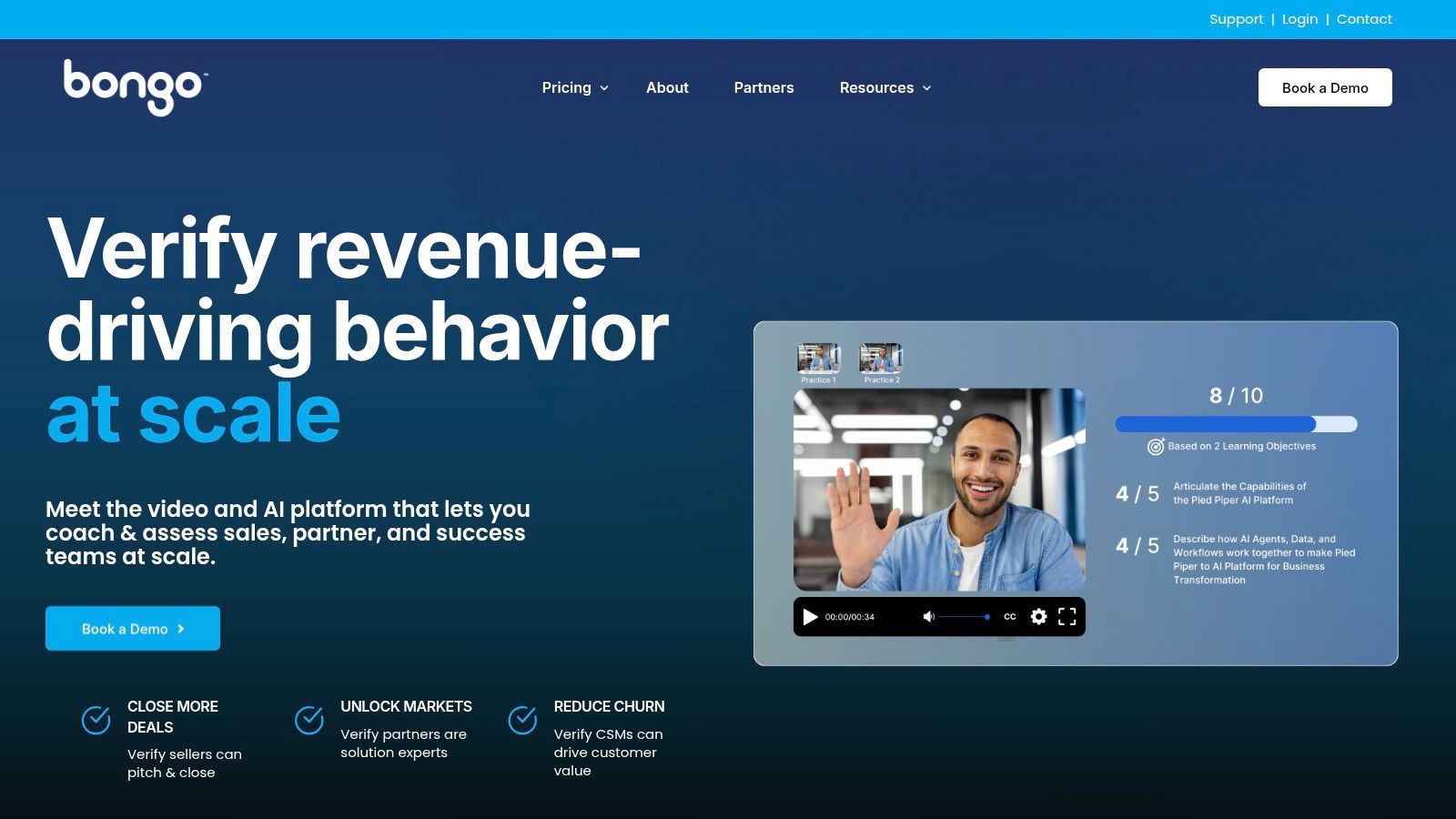
Bongo focuses on verifying the skills of sales, partner, and customer success teams, and it also sells to higher education. Assignment types include AI Role Play, individual video assessments, Q&A with follow-up questions, and interactive video with prompts inside course content. Its AI Coach comments on clarity, tone, delivery, filler words, and content alignment, and Auto Analysis scores certification attempts against the same standard. Bongo also offers peer review and time-stamped feedback, and it integrates with Canvas, Blackboard, Moodle, D2L Brightspace, and Sakai (Bongo for higher education). Bongo states that customer videos are not used to train public AI models. Pricing is by quote.
GoReact vs Bongo
Both score recorded performances with time-stamped feedback, rubrics, peer review, and AI analysis of delivery. GoReact publishes per-user prices and adds multi-camera recording and live observation, which suits teacher education and clinical programs. Bongo puts more weight on sales and partner certification, with AI role play and auto-scored attempts. To decide, ask both vendors to score the same three sample recordings, then compare the reviewer time each one takes.
One-way video interview and hiring assessment tools
These products were built for recruiting. Candidates answer set questions on video in their own time, and the hiring team rates the recordings. Some companies use them to screen employees for a new internal role, but they do not teach, offer retries, or report to an LMS. To assess employees after training, start with the first two groups.
HireVue
HireVue combines video interviews, AI screening interviews, and a live interview co-pilot that joins Zoom or Teams calls with job-relevant skills tests and game-based assessments. It lists internal mobility as a use case, connects with more than 45 applicant tracking systems, and names SOC, ISO, and FedRAMP among its security credentials. Pricing is not published.
Spark Hire
Spark Hire targets small and midsize hiring teams with one-way video interviews, behavioral assessments, and an applicant tracking system. Its video interview software includes unlimited one-way and live interviews for $249 a month billed annually with unlimited users and jobs, or $299 a month billed monthly for up to 5 users and 5 jobs (Spark Hire pricing, checked October 2026). It integrates with more than 100 providers.
VidCruiter
VidCruiter runs pre-recorded and live interviews. For pre-recorded interviews, you set prep time, response length, and re-record options, and you can ask each question as text or as a recorded video. In live interviews, rating guides sit next to the candidate's video. Its AI candidate screening scores answers on a 1 to 5 scale and writes the reason for each score. VidCruiter lists SOC 2 Type II and ISO 27001 among its certifications, offers data residency options, and prices by quote.
Willo
Willo sends candidates a link to a one-way video interview that works on any device, with no app to install. It is ISO 27001 certified, connects to more than 50 applicant tracking systems, and adds transcripts, summaries, and match percentages through Willo Intelligence. Willo Lite is pay-as-you-go with no contract, and Willo Enterprise uses an annual contract.
Harver
Harver's video interview asks up to 4 questions, with about 2 minutes for each answer. It can blur faces, so reviewers judge the answer before they see the person. Harver pairs interviews with its cognitive ability, personality, and culture fit assessments, and it states that its virtual interviewing does not use automated decision-making or facial or micro-expression analysis.
TestGorilla
TestGorilla offers a library of more than 350 skills tests alongside video questions and AI interviews. The free plan includes 10 credits a month, and each video question uses 1 credit per candidate. Core starts at $215 a month billed annually (TestGorilla pricing, checked October 2026).
Video assessment tools with AI
"AI" means different things across these products. Ask each vendor which of these jobs its AI does:
- transcribe and summarize recordings (GoReact, VidCruiter, Willo)
- score delivery, such as pace, filler words, and clarity (GoReact, Bongo)
- score the content of an answer (Bongo Auto Analysis, VidCruiter AI candidate screening)
- run the interview itself (HireVue, TestGorilla)
- draft questions that you review before use (Mindstamp, from a video transcript, and our free video quiz generator)
Have a person review any AI score that affects a grade or a job. The EU AI Act lists AI systems that evaluate learning outcomes, and AI systems that screen or select job applicants, among its high-risk uses (Annex III of Regulation (EU) 2024/1689). Universities and employers in Europe should ask each vendor how it tests its AI scores and who reviews them.
How to choose a video assessment tool
- Name the evidence you need. Use in-video questions to check recall and judgment. Use recorded demonstrations when the skill is a performance, such as a sales pitch or a clinical procedure. Use interview tools for hiring.
- Count the review time. Recordings need a reviewer: 40 learners who each submit a 10-minute video add up to 400 minutes of viewing before anyone writes feedback. Scored in-video questions need no reviewer.
- Decide where results must go. Panopto, Kaltura, YuJa, GoReact, and Bongo connect to LMS gradebooks. Mindstamp reports completion and a score through a SCORM package. Hiring tools connect to applicant tracking systems.
- Check security and data location. Ask about encryption in transit and at rest, single sign-on, data residency, and whether your videos train the vendor's AI models. Ask for a data processing agreement if you work under the GDPR.
- Check accessibility. Look for captions, keyboard access, and read-aloud support, and ask for a VPAT if your organization requires one. VidCruiter lists a VPAT. Mindstamp does not publish one.
- Run a pilot with one real course or role. Read the reports and decide whether they change what you do next.
How to build an in-video assessment
If in-video questions fit your need, this is the setup we recommend in Mindstamp. The same steps apply in most tools.
- List the decisions a learner must make on the job, and write one question for each. Our free video knowledge check generator suggests where each check belongs in a transcript.
- Place each question right after the segment that teaches it. Do not save every question for the end. Across 8.07 million views of 18,315 Mindstamp videos (2018 to October 2026), the average view of a video longer than 20 minutes played 41.7% of it. A quiz placed only at the end of a long video misses every viewer who stops early. Many factors differ between videos, so treat this as a pattern, not proof.
- Make the questions required: turn off Allow skipping on each question, turn off seeking, and turn on Prevent passing required interactions.
- Write feedback for each answer. Send a wrong answer back to the explanation with Change Time, or turn on Repeat Until Correct.
- Set the pass mark where you use it: on a certificate, on completion emails, or on the completion report.
- Test in a private browser window. Owner preview does not save responses, so answer as a learner and check that the report shows your attempt.
- After the first group of learners finishes, open the question breakdown. A question most people miss usually points to a segment that needs a clearer explanation.
Common questions
What interactive training video tools let employees take assessments during videos and track completion automatically?
Mindstamp, Panopto, Kaltura, and YuJa all add questions to video and record each person's answers. Mindstamp tracks watched percentage, answers, and attempts for each learner, and a SCORM package sends completion and a score to your LMS. Panopto and YuJa send quiz scores to an LMS gradebook. For completion records to join up across videos, each learner must be identified, for example by LMS sign-in or by email.
What tools combine stats and video for deeper evaluations?
In-video question tools put viewing data and answers in one record: you see how much of the video a person watched and how they answered each question. Coaching tools such as GoReact add scores, markers, and progress reports on recorded performances. For the wider question of whether training changed behavior on the job, see our guides to training evaluation methods and measuring training effectiveness.
Which video assessment tools work inside an LMS?
Panopto, Kaltura, YuJa, GoReact, and Bongo integrate with major LMS platforms such as Canvas, Blackboard, D2L Brightspace, and Moodle. Mindstamp delivers through your LMS with a SCORM package, an embed, or a link. Security features vary by vendor and plan, so ask each one for its encryption, single sign-on, and data storage details in writing.
Can I use a hiring video interview tool to assess employees?
Yes, for a structured interview such as an internal promotion screen. For training, these tools lack teaching content, retries, and LMS reporting, and AI scoring in hiring tools brings legal duties in some places. A video submission tool or in-video questions fit training better.
Is there a free video assessment tool?
TestGorilla has a free plan with 10 credits a month. GoReact offers a 60-day free trial, and Mindstamp offers a 14-day free trial with no payment card. Teachers can also use Edpuzzle's free Basic plan, which our list of online assessment tools for teachers covers with other classroom options.
How do video assessments differ from formative assessment tools?
A video assessment uses video as the material or as the answer. A formative assessment tool can use any format, and its job is to check understanding while learning is still under way. Many in-video questions are formative checks. Our roundup of formative assessment online tools covers live quizzes, lesson platforms, and forms for that job.
Pick one course or role, decide which of the three types of evidence you need, and trial two tools from that group with the same content. If the answer is questions inside your training videos, you can add them to a video you already have with a 14-day Mindstamp trial that needs no payment card.