When you hear "shoppable video," your mind probably jumps straight to e-commerce. It makes sense—these platforms were born in retail to close the gap between seeing a product and buying it. But that same interactive technology has found its most powerful application in corporate training and development.
Forget the 'buy now' button. Instead, think of clickable hotspots that highlight safety hazards, in-video questions that check for understanding, and branching scenarios that simulate real-world decisions. Platforms like Mindstamp are designed to create engaging, interactive learning content that transforms training from a passive lecture into an active experience.
How Interactive Video Is Reshaping Corporate Training
Let's be honest: the biggest hurdle in corporate learning and development (L&D) has always been engagement. We've all been there, hitting 'play' on a training video while our minds (and maybe a second browser tab) wander elsewhere. Traditional videos are scalable, sure, but they’re passive. That leads to spotty retention and a pretty questionable ROI on your training budget.
This is where interactive video platforms completely change the game.
These tools were built to turn passive watchers into active participants. For corporate training, this interactive toolkit turns employees into engaged learners. The goal isn't a sale, it's comprehension—and the mechanics that get you there are incredibly effective.
From Passive Viewing to Active Learning
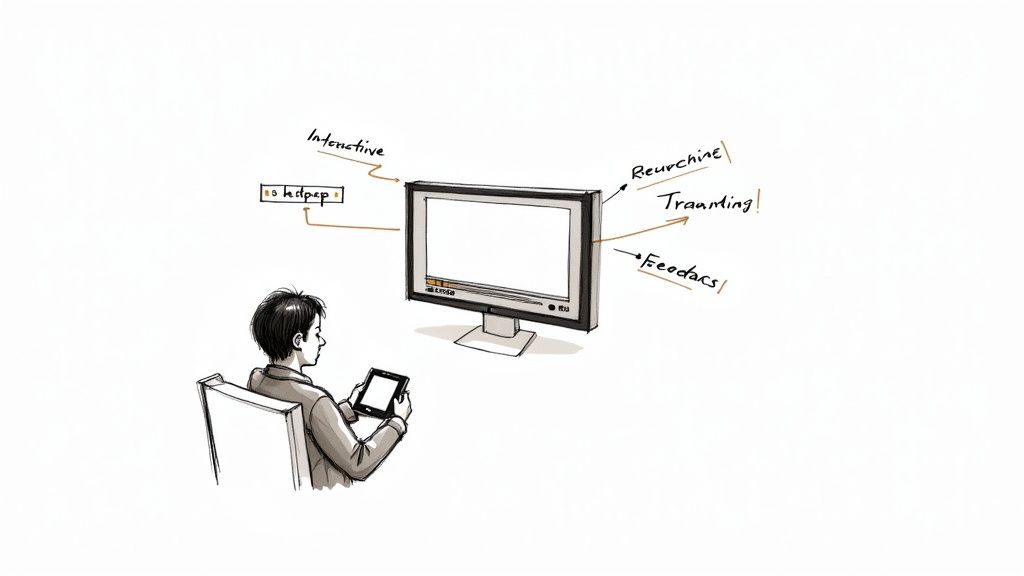
The leap from watching content to mastering skills is surprisingly small with the right tools. An interactive video platform like Mindstamp lets L&D teams drop different interactive elements right into their training content, forcing the viewer to pay attention and participate.
This one change completely flips the learning dynamic. Instead of just zoning out during a safety protocol video, an employee now has to physically click on identified hazards to move forward. An onboarding module for new software becomes a hands-on simulation where they have to click the right menu items to finish a task.
By borrowing engagement tactics, corporate training can finally solve its biggest problem: learner apathy. Interactive video demands participation, making learning something you do, not just something you watch.
Comparing Training Methodologies
The difference is night and day when you put traditional video training side-by-side with an interactive approach. Think about how each one handles a standard compliance module.
| Feature | Traditional Video Training | Interactive Video Training |
|---|---|---|
| Learner Role | Passive Observer | Active Participant |
| Comprehension | Guessed at or tested later | Measured in real-time with questions |
| Feedback | Delayed or nonexistent | Instantaneous and in-context |
| Data & Analytics | Tracks views and maybe completions | Tracks every single click and answer |
This shift results in a far more effective and measurable L&D strategy. The data from interactive video gives you incredible insight into where your team is struggling, which concepts aren't landing, and who has truly mastered the material. It transforms training from a box-checking exercise into a data-backed tool for real skill development, building a more competent and engaged workforce.
Essential Features for Training and Development Platforms
When you select an interactive video platform for corporate training, the goalposts are completely different from e-commerce. You're no longer chasing sales; you're driving learning outcomes. Success isn't measured by clicks-to-cart, but by how well an employee can demonstrate a new skill or retain critical information.
This means you need to look for a toolset that's built to create, measure, and scale real learning experiences. The key is finding a platform that turns passive video watching into an active, measurable training event.
Core Interactivity for Learner Engagement
At its heart, an effective training video needs to demand participation. Simple clickable hotspots can be used to have learners identify safety hazards in a factory or point out key features in a new software walkthrough. This basic level of interaction is a great first step to make sure your team is actually paying attention.
But for true skill-building, you'll need more than just hotspots. Look for platforms that give you a variety of in-video question types—multiple choice, open-ended responses, or even fill-in-the-blanks. These tools act as instant knowledge checks, giving immediate feedback to both the employee and the training manager.
The most powerful training features are the ones that create a feedback loop. When an employee can test what they know and get immediate correction or reinforcement right inside the video, the whole process becomes dynamic and far more effective than just hitting play.
Advanced Logic and Personalization
Let's face it: not everyone learns at the same speed or needs the same information. This is where branching logic becomes a game-changer. Based on how a user answers a question, the video can automatically jump to a remedial section for a clearer explanation or skip ahead to more advanced material if they've already mastered the concept.
This lets you build personalized learning paths that cater to individual needs. For instance:
- A sales trainee answers a question about handling objections incorrectly. The video can instantly route them to a quick scenario showing the right way to respond.
- An engineer aces an initial quiz on a new system. They can bypass all the introductory fluff and jump right into the advanced troubleshooting modules.
This kind of personalization makes training incredibly efficient. You're addressing specific knowledge gaps without forcing your experts to sit through content they already know.
When you start thinking about training, it's helpful to translate common interactive features into their learning and development (L&D) equivalents. What drives a purchase in one context can drive knowledge retention in another.
Translating Interactive Features for L&D Impact
Here’s a breakdown of how standard interactive features are adapted to create powerful corporate training tools.
| Standard Interactive Feature | Effective Corporate Training Application | Key Metric for L&D Success |
|---|---|---|
| "Add to Cart" Button | In-video quiz questions, knowledge checks. | Correct answer rate, completion score. |
| Product Hotspots | Identifying parts, labeling safety hazards. | Interaction rate, accuracy of selections. |
| "Shop the Look" Carousel | Resource library with links to documents, guides. | Click-through rate on supplemental materials. |
| Personalized Recommendations | Branching logic to create custom learning paths. | Time to completion, mastery of advanced topics. |
| Customer Reviews | Open-ended questions for feedback or scenarios. | Qualitative analysis of responses. |
This table shows that the same underlying technology can serve completely different goals. It’s all about reframing the interaction from a transaction to a learning moment.
Analytics and LMS Integration
If you can't measure it, you can't improve it. E-commerce platforms track conversion rates, but a solid training platform needs to deliver deep analytics on learner performance. Go way beyond simple view counts. You need a platform that provides granular data on:
- Individual question responses: Quickly spot which topics your entire team is struggling with.
- Viewer drop-off points: Pinpoint exactly where your videos are losing people's attention.
- Per-user progress reports: Track an individual's complete learning journey for compliance and performance reviews.
To be truly useful in a corporate setting, the platform has to integrate seamlessly with your existing Learning Management System (LMS). This is non-negotiable. You need completion data and quiz scores to pass back automatically to an employee's official training record, which makes compliance tracking and program management a breeze. Modern platforms should also be thinking about leveraging API support for new actions and other integrations, similar to how tools like Microsoft Teams are expanding, to offer maximum flexibility.
The screenshot below gives you a good idea of what this looks like in practice—a suite of features that connects interactive elements to a powerful analytics engine.
This is the combination you're looking for. Features like questions, branching, and personalization are tied directly to analytics, allowing you to not only build effective training but also prove its impact. The right platform gives you actionable data that demonstrates the ROI of your training programs.
Comparing the Top Interactive Video Platforms
Choosing the right interactive video platform goes way beyond ticking boxes on a feature list. If you're a corporate training manager, your decision is going to hang on the subtle details—the things that actually move the needle on learning outcomes, keep company data safe, and can scale with your team. This is where you start to see the real differences between platforms when they're put to work for learning and development.
Let's put Mindstamp head-to-head with some other well-known tools. We'll focus on what truly matters for corporate training: how deep the analytics go, how easy it is to build complex learning journeys, and the kind of security you need to protect sensitive information. The idea is to get past the shiny marketing claims and give you a real framework for picking the right tool for your organization.
Analytics Deep Dive: From Clicks to Comprehension
The real magic of interactive video in training is the data it kicks back. But let's be honest, not all analytics are created equal. A lot of platforms will give you the basics, like click tracking and view counts. That's fine, but it doesn't tell you if anyone actually learned anything.
A platform like Vimeo offers great video hosting and some basic interaction data, which is perfect for simple marketing videos. But when you’re dealing with a high-stakes training scenario, you need to dig much, much deeper.
A truly effective training platform doesn't just show you what a learner clicked; it helps you understand why. This means tracking not only responses but also hesitation, repeat viewings of a specific segment, and the path they took to arrive at an answer.
This is where Mindstamp really shines. It gives you per-user heatmaps and incredibly detailed response reports. As a training manager, you can pinpoint exactly where an employee got stuck in a compliance video. You can see which questions in a new product tutorial tripped up the entire team. That level of detail turns your analytics from a simple report card into a powerful diagnostic tool, helping you constantly tweak and improve your training content.
Creating Complex Learning Paths
Good training isn't one-size-fits-all. You need to create experiences that adapt to the learner, especially for tricky subjects like compliance, sales simulations, or technical certifications. This is where branching logic becomes your best friend.
Plenty of platforms offer some kind of branching, but how they do it varies wildly. Tools built for e-commerce, like Vidjet or Videowise, are usually designed to funnel a user toward a sale. Their branching is often straightforward: from a product feature to a checkout page.
For corporate training, the logic has to be smarter. A sales trainee who fumbles an objection-handling question shouldn't just see a "wrong answer" message. They should be automatically routed to a different video branch that breaks down the correct technique. On the flip side, an experienced team member who nails the first few questions should be able to skip the intro modules altogether.
Mindstamp was built with this exact teaching mindset. Its interface is surprisingly intuitive, letting trainers build out these complex, multi-layered branching scenarios without having to call IT for help. You can create realistic simulations where the video actually changes direction based on the learner's decisions in real-time. It’s a game-changer for creating training that feels personal and engaging.
One of the first big questions you'll face is whether you need to tie everything into a formal Learning Management System (LMS). This little decision tree can help you figure out which path to start down.
As you can see, needing an LMS integration immediately points you toward platforms built for structured corporate learning, while standalone tools might be all you need for more informal or marketing-style videos.
Security and Integration Capabilities
This one’s a big deal: protecting your company’s proprietary information is non-negotiable. When you’re evaluating platforms, security features have to be at the top of your list, especially if your training videos contain sensitive product specs, internal processes, or confidential sales strategies.
Here are a few key security and integration points to grill vendors on:
- Access Control: Can you lock down videos with single sign-on (SSO), password protection, or by specific email domains?
- Data Privacy: Does the platform meet the data protection rules that matter for your industry and region (like GDPR or CCPA)?
- LMS Integration: How well does it play with your current LMS, whether that’s Cornerstone, Docebo, Moodle, or something else? A smooth integration means completion data, scores, and certificates automatically sync up with an employee's official training record.
- Content Management: How does the platform handle storing and organizing your videos? If you're building a large library, you need a solid system. To get a better sense of what this involves, check out our guide on video content management systems.
Mindstamp ticks these boxes with enterprise-level security, including SSO and solid privacy controls. Its deep integrations with major LMS and CRM systems mean your interactive videos become a seamless part of your existing tech stack, not just another isolated tool. That holistic approach makes it a much stronger choice for organizations needing a secure, integrated, and scalable solution for corporate training.
Putting Interactive Video to Work in Your Organization
The theory behind interactive video is one thing, but seeing it in action is where you really grasp its power. These platforms aren't just about cool features; they're about turning passive content into active learning experiences that drive real business results.
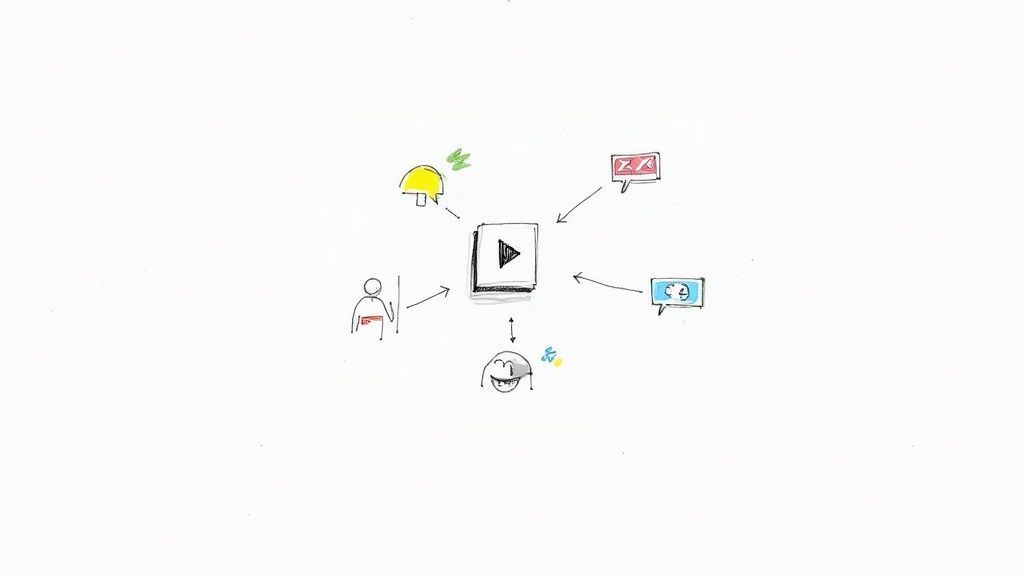
Take new hire onboarding. From day one, you can get employees to engage with critical information in a meaningful way, making sure they truly understand company culture and procedures before even meeting their team. It completely flips the traditional training model from a one-way lecture to a two-way dialogue between the employee and the content.
Transforming Onboarding and Compliance
Think about the typical onboarding process—it's often a whirlwind of presentations and documents that quickly become a blur. With an interactive video platform, you can turn that firehose of information into a self-paced, engaging journey.
- The Challenge: New hires are overwhelmed with information, which leads to poor retention of crucial company policies.
- The Interactive Fix: Create a series of short videos with questions embedded after each key policy. You can even gate progress, meaning an employee has to correctly answer a question about data security before they can move on.
- The Bottom-Line Result: L&D managers can see, in real-time, who has completed and actually understood the core compliance training. This creates a clear, auditable record of comprehension and significantly cuts down on compliance risk.
This same idea is incredibly powerful for safety training. Imagine a module for a manufacturing plant where employees have to physically click on potential hazards they spot in a video of the factory floor. It’s a far more effective way to confirm knowledge than just having them watch a passive video.
Building Sophisticated Sales Simulations
Getting a sales team ready to handle tough client objections is another perfect use case. Role-playing and static scripts often feel forced and artificial. Interactive video, however, lets you build sophisticated simulations that feel like real-world sales conversations.
A sales rep watches a video of a client raising a common objection. The video pauses, and the rep is presented with several ways to respond.
By choosing a response, the rep is immediately taken down a unique video path showing the likely outcome of that choice. This branching logic creates a consequence-based learning environment that's incredibly effective for building confidence and situational awareness.
This approach gives your team a safe place to fail, where a wrong choice becomes a coaching moment instead of a lost deal. Plus, the analytics can show you which objections your reps struggle with the most, pointing you toward topics for targeted team coaching.
Enhancing Product Knowledge and Support
When you launch a new product or a major software update, getting everyone up to speed fast is essential. Interactive tutorials offer on-demand learning that lets employees explore the new features at their own pace.
A simple product tutorial can be layered with clickable hotspots over different features. When an employee clicks on a hotspot, a pop-up can appear with more detail, a quick video explanation, or a link to a technical spec sheet. A linear video instantly becomes a rich, explorable resource.
While these training examples don't involve a literal "purchase," they use the exact same engagement mechanics that make shoppable video platforms so effective for e-commerce. The core technology is proven to hold attention and drive action. For instance, data shows that 41% of viewers who engage with shoppable video content end up making a purchase, and that engagement can lead to a ninefold increase in purchase intent.
For internal training, that same power translates directly to higher comprehension and better job performance, making a clear business case for bringing an interactive shoppable video platform into your organization.
How to Measure and Justify Your Investment
Getting the budget for any new tech means building a rock-solid business case, and that always comes down to measurable return on investment (ROI). When you're trying to justify an interactive video platform for training, you have to look past vanity metrics like "views" and focus on real business outcomes. Thankfully, the detailed analytics baked into these platforms give you exactly the data you need to prove their value and get your stakeholders nodding along.
The trick is to connect the dots between interactive video features and the key performance indicators (KPIs) your leadership team already obsesses over. Stop talking about "engagement" and start talking about a measurable drop in the time it takes for a new hire to become fully productive. This simple shift reframes the platform from just another training tool into a strategic asset that builds a better workforce.
Tracking Metrics That Actually Matter for Training
To build your case, you have to track the right data. A platform like Mindstamp is built to give you the kind of granular insights that you just can't get from a standard video host.
Here are the critical metrics to zero in on:
- Reduced Time-to-Competency: How quickly are new hires finishing their interactive onboarding modules compared to the old way? A faster ramp-up time means your people are contributing to business goals sooner. That’s a direct and powerful ROI metric right there.
- Improved Performance Scores: For your sales and support folks, track how interactive training impacts their actual job performance. Are close rates going up for salespeople? Are customer satisfaction scores climbing for support agents after they complete simulation-based training?
- Lower Compliance Risk: Use in-video quizzes to create a clear, auditable trail showing that employees understood mandatory compliance training. Being able to demonstrate a 100% completion and comprehension rate on safety or data security is a powerful way to justify the cost by highlighting risk reduction.
Contrasting Costs and Calculating ROI
Next up, you need to lay out the costs of sticking with outdated training methods versus the benefits of having a more engaged, skilled workforce. The "hidden costs" of passive training are huge—think lower productivity, higher employee turnover from bad onboarding, and the ever-present threat of expensive compliance screw-ups.
Your business case should make it clear that this isn't just about buying software; it's a strategic move to cut risk and boost performance. The data you get from interactive video makes this connection undeniable, turning fuzzy training goals into hard numbers.
The explosive growth of video commerce only makes the argument stronger. The global market is projected to skyrocket from $917.4 billion to an astonishing $14.4 trillion by 2034, growing at a compound annual rate of about 31.7%. While e-commerce is driving that surge, it proves one thing: interactive technology is incredibly effective at grabbing attention and getting people to act—which is exactly what you need for great training.
It's also worth looking at how you can be more efficient in creating the content itself. New tools are making it way easier and cheaper to produce the assets needed for these interactive experiences. For example, looking into how an AI product photo generator can slash content creation costs provides a great parallel argument for adopting modern tools to improve ROI. A winning business case connects the platform's capabilities to both performance gains and operational savings, giving stakeholders the full financial picture.
For a deeper dive into these concepts, check out our detailed guide on how to measure training effectiveness.
A Practical Guide to Getting Implementation Right
So, you've picked a platform. Now what? Making the switch to an interactive video strategy is more than just buying new software—it’s about having a clear roadmap to get it adopted and integrated.
The goal is simple: turn your library of passive videos into engaging, measurable assets that actually fit into how you already do things. It's about launching, getting feedback, and then scaling up in a way that people actually want to use it.
The best way to start is with a small, focused pilot program. Don't try to boil the ocean by redoing your entire training catalog overnight. Pick one critical module—maybe new hire compliance or a key product update—and turn that into an interactive experience first. This lets you show real value quickly and builds the momentum you'll need.
Integrating with Your Existing Tech Stack
This is a big one. Your new interactive video tool has to talk to your other systems, especially your Learning Management System (LMS) or even your CRM. A platform like Mindstamp needs to be able to automatically push completion data, quiz scores, and detailed analytics back into an employee’s official training record.
This technical handshake is absolutely non-negotiable for a few reasons:
- Centralized Reporting: It keeps all your learner data in one spot. This makes compliance tracking and performance reviews so much easier.
- A Smooth User Experience: Your team can get to the interactive training right from the LMS they’re already logging into every day. No new passwords to remember.
- Automated Workflows: This is a huge time-saver. It gets rid of manual data entry for your L&D admins, freeing them up and cutting down on mistakes.
Designing Content That Actually Engages
Simply adding a few clickable buttons to an old video isn't enough. You have to completely rethink the learning experience. The best practice is to start with clear learning objectives and then work backward, building interactions that directly support those goals.
The most effective interactive videos feel like a conversation, not a lecture. Use questions to make people stop and think, branching scenarios to let them practice making real-world decisions, and hotspots to encourage them to explore. Every single interaction should have a purpose.
This shifts training from a lean-back, passive activity into an active, problem-solving exercise.
It's a principle that's been proven in e-commerce, where shoppable video adoption has soared to 70% in the US with average conversion rates hitting 12%. The same engagement tactics that power a $18 billion global video commerce market are just as effective at driving knowledge retention and skill mastery. You can see more of these e-commerce stats and trends on Channelize.io.
By launching a smart pilot, listening to feedback, and then scaling across the organization, you can nail the implementation and get the most out of every video.
Common Questions Answered
We get a lot of questions about how these platforms fit into different business environments, especially when it comes to training. Let's tackle a few of the most common ones.
Can Platforms Built for E-commerce Actually Work for Training?
Yes, and surprisingly well. It might seem odd to use a sales-focused tool for internal training, but the core mechanics are the same. These platforms are built from the ground up to get a viewer to do something and to track every single interaction.
For corporate training, you just repurpose that functionality. An "add to cart" button can easily become a quiz question. A product hotspot can be used to highlight critical safety information on a piece of machinery. The goal isn't to make a sale, but to confirm someone understood the material—and the interactive features are perfect for that.
How Do These Platforms Integrate with an LMS?
This is a big one. For any serious corporate training program, your interactive video tool has to talk to your Learning Management System (LMS). Fortunately, most platforms designed with business use in mind, like Mindstamp, handle this smoothly.
Typically, this is done through standards like SCORM or a direct API connection. A solid integration means all the important data—like who completed the video, their quiz scores, and which parts they interacted with—flows automatically into the employee's training record in the LMS. This is non-negotiable for compliance and tracking real progress.
The key is making sure the integration feels invisible. The video should feel like a natural part of your existing training courses, not some clunky, bolted-on tool that forces admins to manually enter data or makes employees use a separate login.
What Is the Best Way to Measure Training ROI?
You have to look beyond simple view counts. To really prove the value of interactive video for training, you need to connect it to actual business results.
Start tracking improvements in key areas like:
- Time-to-competency: Are new hires getting up to speed and hitting their performance goals faster?
- Performance metrics: After a sales training video, are close rates going up? Are customer satisfaction scores improving post-service training?
- Compliance rates: Are you seeing higher scores and better retention on mandatory policy or safety training?
When you can draw a direct line from your interactive training data to these kinds of tangible outcomes, building the business case for your investment becomes incredibly easy.
Ready to stop creating passive training videos and start building active learning experiences? See for yourself how Mindstamp can help you create training content that's more engaging, measurable, and effective. Start your free trial today and see what a difference interactive video can make.