 Brett Lindenberg
Effective sales training picks a few selling behaviors that your own lost deals show reps need, has reps practice them against realistic buyer moments, gives specific feedback, and brings the same skills back over several weeks while managers coach them on live calls. A one-day workshop with no follow-up rarely changes what reps say to buyers. This guide covers ten sales training best practices, a comparison of training methods, a 90-day sales training plan, and what changes for field and global teams. The drill below takes under a minute: a buyer pushes back, and you choose the rep's next line.
What makes sales training effective
Most sales skills training follows the pattern researchers call behavior modeling: describe the skill, show someone using it, have learners practice, give feedback, and support the skill back on the job. A 2005 meta-analysis of 117 studies in the Journal of Applied Psychology (Taylor, Russ-Eft, and Chan) found that this kind of training produced its largest effects on knowledge and skills and smaller effects on job behavior. Skills and job behavior held steady or grew over time, while factual knowledge faded. The study also found the conditions under which trained behavior carried over to the job. Transfer was greatest when the training:
- showed both good and poor examples of the skill
- had trainees practice with scenarios they wrote themselves
- asked trainees to set goals for using the skill
- trained the trainees' managers as well
- added rewards and consequences in the work environment
Use those five conditions as a checklist for any sales program. Practices 3, 4, 6, and 9 below come from them.
The second body of evidence concerns memory. In 2015, Murre and Dros replicated Ebbinghaus's forgetting curve in PLOS ONE: memory for new material drops fastest in the first hours and the first day, then levels off. Two study habits slow that loss. A 2013 review by Dunlosky and colleagues rated practice testing and spaced practice the most useful of ten learning techniques, and rereading and highlighting among the least useful. In a 2006 experiment by Roediger and Karpicke, students who took recall tests remembered more after two days and after one week than students who restudied the same text. For a sales team, quizzing reps and spreading practice over weeks does more than asking them to reread the playbook.
10 sales training best practices
1. Start from the deals you lose
Build your sales training strategy on evidence from your own pipeline. Pull the reasons for recent losses, the conversion rate between each pipeline stage, and a sample of recorded calls. Ask managers and reps where deals stall. Look for the stage where good opportunities stop moving.
Then pick two or three skills to train this quarter. If demos convert well but first calls rarely produce a second meeting, train discovery before product knowledge. If deals die in procurement, train qualification and multi-threading. A training needs assessment gives you a repeatable way to run this step each quarter.
2. Write each skill as a behavior you can observe
"Good at discovery" is a trait. A manager cannot score it on a call. Rewrite each skill as two or three actions anyone can see or hear, for example:
- Asks what the problem costs the buyer before showing the product.
- Confirms who else signs off and what they need to see.
- Ends the call with a dated next step the buyer agreed to.
Use the same list as the scoring rubric in role-plays, call reviews, and ride-alongs. When every coach scores the same behaviors, reps get consistent feedback and you can compare results across teams.
3. Show a strong and a weak version of the same moment
The 2005 meta-analysis found better transfer when training showed both positive and negative models. In practice, record two or three takes of the same buyer objection: one reply that works and one or two that sound reasonable but fail. Ask reps to name the difference before you explain it.
The drill at the top of this page uses this pattern. The feature list and the discount both sound helpful in the moment. The discovery question is the only reply that asks about the buyer's problem.
4. Practice on the reps' own deals
Practice with scenarios that trainees wrote themselves also improved transfer in the same research. Ask each rep to bring a real objection or a stalled deal from their pipeline. A partner plays the buyer from the rep's notes, then they swap roles. Playing the skeptical buyer or the procurement lead teaches reps how their pitch sounds from the other side of the table.
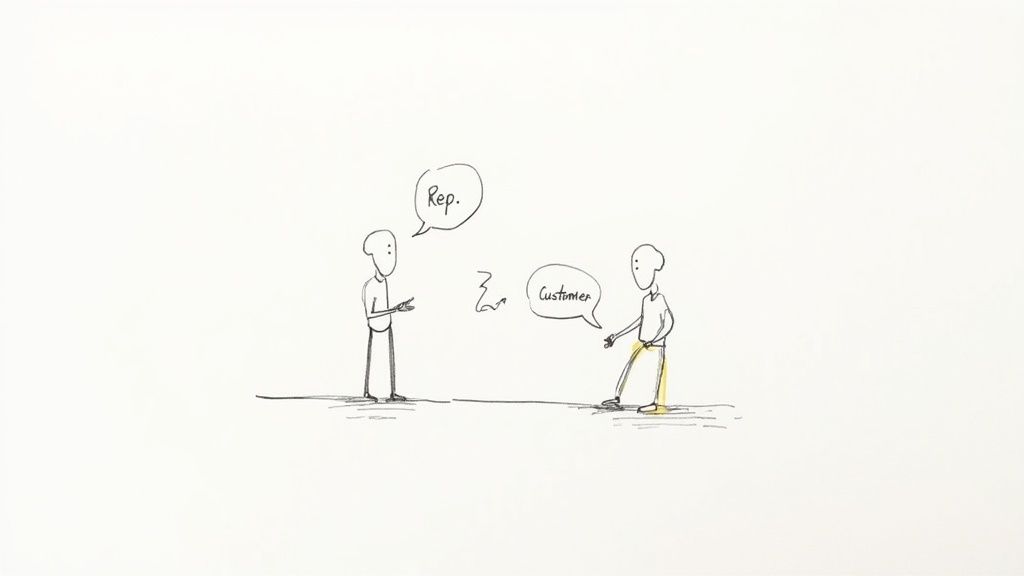
Start with low-stakes moments, such as booking a first meeting, before multi-stakeholder negotiations. Record sessions with permission and score them against the rubric from practice 2. For structured scenarios that reps can run alone, see our guide to scenario-based training.
5. Space practice and quiz recall over weeks
Spacing works best when the gap between reviews fits how long reps must remember the material. In a 2008 study of more than 1,350 people, Cepeda and colleagues found that the best gap was about 20 to 40% of the time until a test one week away, and about 5 to 10% of the time until a test one year away. For pricing rules or a competitive story that reps need all year, that points to a review roughly every three to five weeks.
Make each review a retrieval task. Ask "What would you say next?" or "Which plan fits this buyer?" instead of replaying the original session. Short quizzes after each module and a scenario check a few weeks later fit into a rep's week. Our guides to microlearning strategies and knowledge retention strategies cover formats and schedules.
6. Train managers to coach, then coach the middle
Transfer was greater in the 2005 meta-analysis when trainees' managers were trained too. Sales managers decide what reps practice after the workshop ends, so train them first, on the same rubric.
Then point coaching time at the right reps. In a 2011 Harvard Business Review article, Matthew Dixon and Brent Adamson reported Sales Executive Council research showing that coaching paid off most for the middle 60% of a team, where good coaching improved performance by up to 19%. Managers often spend their time on the best and worst performers instead.
Some sales management best practices follow from this:
- Hold a development one-on-one that is separate from the pipeline review.
- Coach one behavior per session, with an example from a recent call.
- Give feedback with the Center for Creative Leadership's Situation-Behavior-Impact model: name the situation, describe the behavior, and explain its impact.
- Check the same behavior on the next call or ride-along.
7. Pick one sales methodology and certify on it
A shared methodology gives reps and managers the same words for deal reviews. Three common choices:
- SPIN Selling, created by Neil Rackham, organizes discovery into situation, problem, implication, and need-payoff questions. Huthwaite says the model came from research on more than 35,000 sales calls.
- The Challenger model comes from CEB (now Gartner) research that rated sellers on 44 attributes. It trains reps to teach the buyer something new, tailor the message, and take control of the sale.
- MEDDIC, created by Dick Dunkel at PTC in 1996, is a qualification checklist: metrics, economic buyer, decision criteria, decision process, identify pain, and champion.
SPIN and Challenger shape the conversation, and MEDDIC checks whether a deal is real, so many teams pair a conversation model with a qualification model. Choose based on deal size and buying committee. A short transactional sale rarely needs a full MEDDIC review.
Certify on application. A rep passes when they can run a deal review or a recorded role-play using the methodology, scored on your rubric. A multiple-choice test alone does not show that. Recertify when the product, pricing, or ideal customer changes.
8. Put reinforcement where reps already work
Sales teams change often. A Gartner survey of 227 chief sales officers (August and September 2025, published April 2026) found that sales organizations had completed an average of four transformations in the previous 12 months. Gartner advises sales leaders to move beyond static content and training to guidance inside the seller's workflow.
In practice, keep battle cards and objection answers in the CRM record, post a two-minute drill in the team's chat channel before a launch, and attach a short checklist to the calendar invite for each discovery call. Reps should find the answer in the tool they already have open.
9. Use competition for short sprints
A leaderboard can lift participation for a launch or a new skill. Keep competitions short, such as a two-week product quiz before a launch, and reward the behaviors you trained: practice sessions completed, rubric scores, or certified reps. The 2005 meta-analysis found better transfer when the work environment rewarded the trained behavior, so tie at least part of the recognition to using the skill on real calls. Our guide to gamification in sales training covers game mechanics in more detail.
10. Measure behavior and results
Completion rates show who showed up. They say little about what changed on calls. The Kirkpatrick Model separates four levels: reaction, learning, behavior, and results. For sales teams, that maps to:
- Learning: quiz and scenario scores, by skill.
- Behavior: rubric scores from call reviews and ride-alongs.
- Results: stage conversion, win rate, ramp time, and deal size.
Run the program with one team first and compare it with a similar team over the same quarter. That comparison is more convincing than a before-and-after chart for one group. For the details, read our guides to measuring training effectiveness and calculating ROI on training.
Sales training methods and techniques compared
No single method covers every skill. Match the method to the skill and to the evidence you need afterward.
| Method | Best for | What it takes | Evidence you get |
|---|---|---|---|
| Live role-play | Objection handling, negotiation, pricing talks | A trained facilitator and buyer briefs from real deals | Rubric scores and recordings |
| Video scenario drills | Consistent practice for many reps, onboarding, launches | A recorded scenario for each decision point | Each rep's choices, scores, and retries |
| Call recording review | Discovery and demo skills on real calls | Call recordings and manager time | Rubric scores tied to live deals |
| Ride-alongs | Field sales | Manager travel time | Behavior observed in the buyer's setting |
| Spaced quizzes and microlearning | Product facts, pricing rules, competitor claims | A question bank and a schedule | Recall scores over time |
| Deal reviews | Qualification and multi-threading | Live pipeline and a shared methodology | Qualification gaps for each deal |
| Peer mentoring | Ramp time and unwritten know-how | Mentors who are trained to coach | Progress against the mentee's goals |
| Methodology certification | A shared language across teams | An assessment on real or realistic deals | Certified reps and recertification dates |
How to build a sales training plan
A sales training plan turns the practices above into a schedule. Build it in this order:
- Find the two or three skills your pipeline data says matter most.
- Write each skill as observable behaviors and a scoring rubric.
- Train managers on the rubric before reps start.
- Choose one practice method and one reinforcement method for each skill.
- Schedule spaced reviews and a certification point.
- Pilot with one team, measure, and adjust before you scale.
For new reps, the plan usually becomes a 90-day roadmap. Adjust the phases to your sales cycle.
| Phase | Focus | Activities | Proof of progress |
|---|---|---|---|
| Days 1 to 30 | Product, buyer, and sales process | Product quizzes, listening to recorded calls, first role-plays on booking meetings | Quiz scores and a first rubric score |
| Days 31 to 60 | Discovery and demos | Weekly role-plays on the rep's own deals, manager review of recorded calls, spaced product quizzes | Rubric scores on live calls |
| Days 61 to 90 | Objections, qualification, and closing steps | Deal reviews with the methodology, a certification role-play | Certification and stage conversion compared with the team |
| After day 90 | Continuous development | Quarterly skill refresh from win-loss data, spaced quizzes, recertification after major changes | Rubric trends and win rate |
Tenured reps follow the same quarterly cycle: one or two skills per quarter, chosen from the latest pipeline data.
Best practices for field sales training and management
Field sales reps spend their days in cars, lobbies, and customer sites, so their training has to fit between visits and their coaching has to happen on location. The ride-along is the core field sales coaching tool. Run it with a fixed structure:
- Before the visit, the rep states the call objective, the questions they plan to ask, and the objections they expect.
- During the visit, the manager observes and does not take over unless the deal is at risk.
- The same day, the manager gives feedback on one behavior with the Situation-Behavior-Impact model and records a rubric score.
- On the next ride-along, the manager checks that behavior first.
Between visits, give field reps practice they can finish on a phone in a few minutes: a single objection drill, a pricing question, or a competitor comparison. Add captions, because reps often watch without sound. Build the scenarios from objections heard in each territory, since a rural distributor and a city hospital buyer raise different concerns.
Field sales managers also need protected coaching days for reps in the middle of the team. Ride-alongs tend to go to the biggest deals or to reps in trouble, which puts coaching time where the Sales Executive Council research found it pays off least.
How to scale sales training across global teams
Global programs often go wrong in one of two ways: a headquarters curriculum that ignores local buyers, or regions that each build their own program with no shared standard. Split the content into a fixed core and a local layer.
- Keep the methodology, the rubric, and product facts the same everywhere.
- Localize buyer titles, competitors, regulations, examples, and currency.
- Translate the whole experience, including audio, captions, and quiz questions. Mindstamp's video translation works in 57 languages. It can dub the audio and translate questions and buttons in one video, and it keeps product names you mark as protected terms unchanged. A dubbed track keeps only the new voice, so you lose the original music and sound effects.
- Record core content once and repeat live sessions in time-zone blocks.
- Have managers from each region score the same recorded call, then compare scores so a "4" means the same thing everywhere.
- Report scenario scores by region. A low score in one region can point to a translation problem or a market difference.
Sales training trends in 2026
Buyers now do more of the work before they meet a rep. A Gartner survey of 646 B2B buyers (August and September 2025, published March 2026) found that 67% preferred a buying experience without a sales rep, and 45% had used AI during a recent purchase. Reps who get a meeting often face buyers who have already researched the product. Train reps to diagnose the buyer's situation and offer a view the buyer cannot get from a website or an AI answer.
Enablement is also moving into the workflow. In the April 2026 release cited above, Gartner predicted that by 2029, sales organizations with AI-driven enablement would move deals through sales stages 40% faster than those using traditional enablement. This is a forecast, and it shows where vendors and budgets are heading.
AI buyer simulations and automated call scoring make practice cheaper to run at volume. Use them to increase the number of practice reps get, and have managers check a sample of AI scores against your rubric each month so the tool grades the behaviors you care about.
Where interactive video fits in sales training
Live role-play needs a partner and a calendar slot. Interactive video covers the practice and reinforcement steps that a rep can do alone, at any hour, with the same scenario for every rep. In Mindstamp, you add choices and questions to a recorded scenario, and each answer can play a different buyer reaction and coaching note, as in the drill above. A role-based practice example changes the case for sales managers, account executives, and sales engineers.
Features that matter for sales training:
- Video branching sends each reply to its own outcome scene.
- In-video questions pause the video and record each rep's answer, and Repeat Until Correct lets a rep retry a missed question. See how scores and retries work.
- The report shows each rep's answers, attempts, score, and path, so a manager can review choices before the rep's next live call.
- On supported plans, a SCORM package sends completion and score to a compatible LMS.
The sales enablement training page shows how teams use this for objection practice and product knowledge checks. To record the scenarios themselves, our guide to corporate training video production covers planning, scripting, and recording. For the wider program, see our sales enablement strategies.
Common questions
What are the best practices for sales training and development programs that support continual growth for sellers?
Give each career stage its own target behaviors on the same rubric, so a senior rep's next skill is as clear as a new hire's. Agree on one development goal per quarter with each rep, review it in the development one-on-one, and certify it with a scored role-play or deal review. Pair experienced reps with newer ones as mentors, and train the mentors to coach. Recertify everyone when the product, pricing, or target buyer changes.
How do you continuously evolve sales best practices?
Run a quarterly loop. Review win-loss reasons and stage conversion, listen to recorded calls from your top performers to find what they do differently, and update the rubric and scenarios to match. Retire content that no longer reflects how you win. Then measure whether rubric scores and conversion move in the next quarter.
What is the most effective sales training method?
Practice with feedback on realistic scenarios has the best research support, from the behavior modeling studies described above, especially when managers are trained to reinforce it afterward. Pair it with spaced quizzes for facts that reps must recall, such as pricing and competitor claims.
How long does sales training take?
New-rep onboarding usually runs on a 90-day plan, though complex enterprise products can take longer. Tenured reps keep training: plan one or two skills per quarter, with spaced reviews every few weeks.
To start this week, pull your last ten lost deals, find the stage where most of them stalled, and write the skill that would have helped as two behaviors a manager could score. Run one role-play on that skill, then quiz it again three weeks later.