 Brett Lindenberg
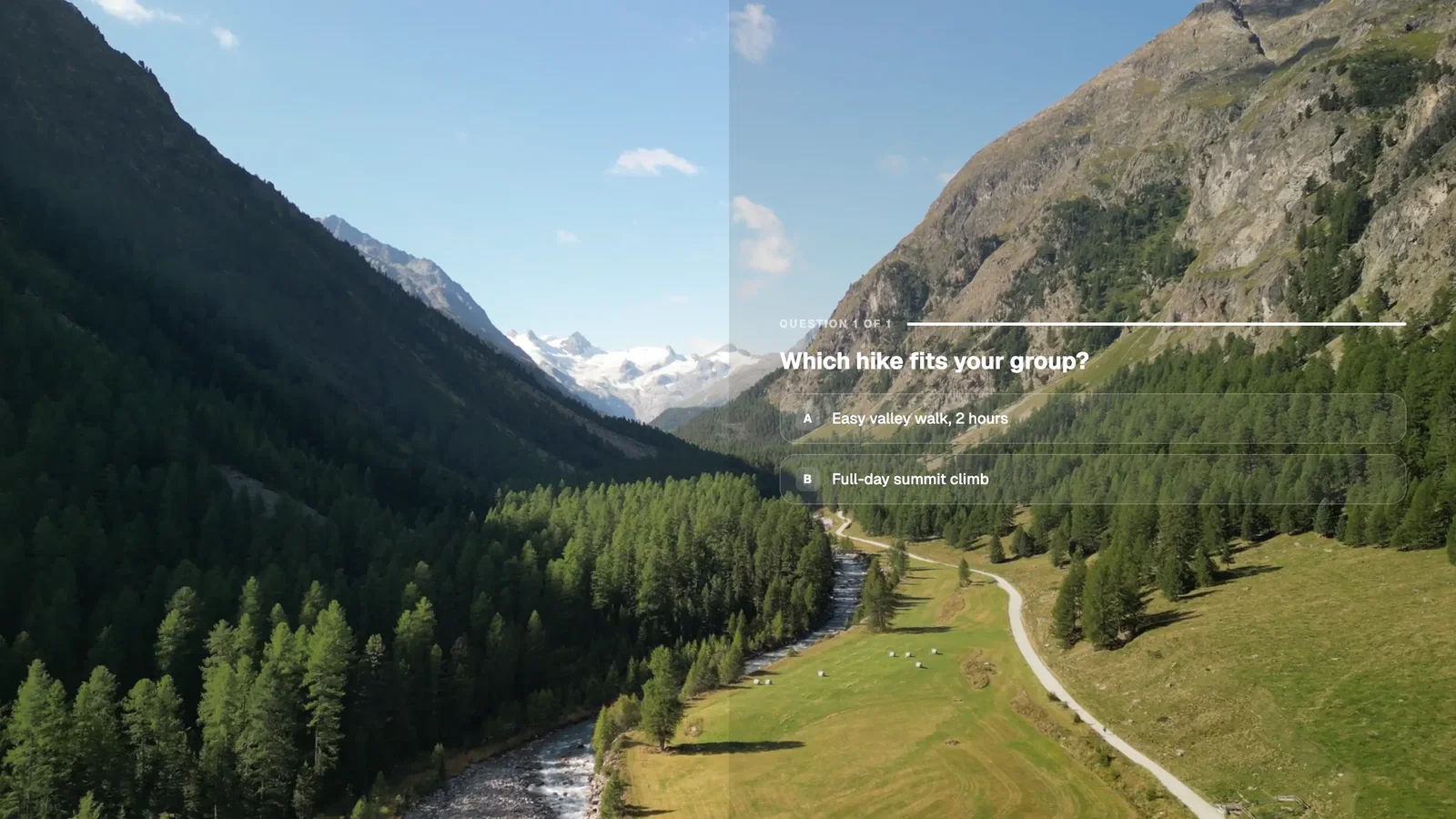
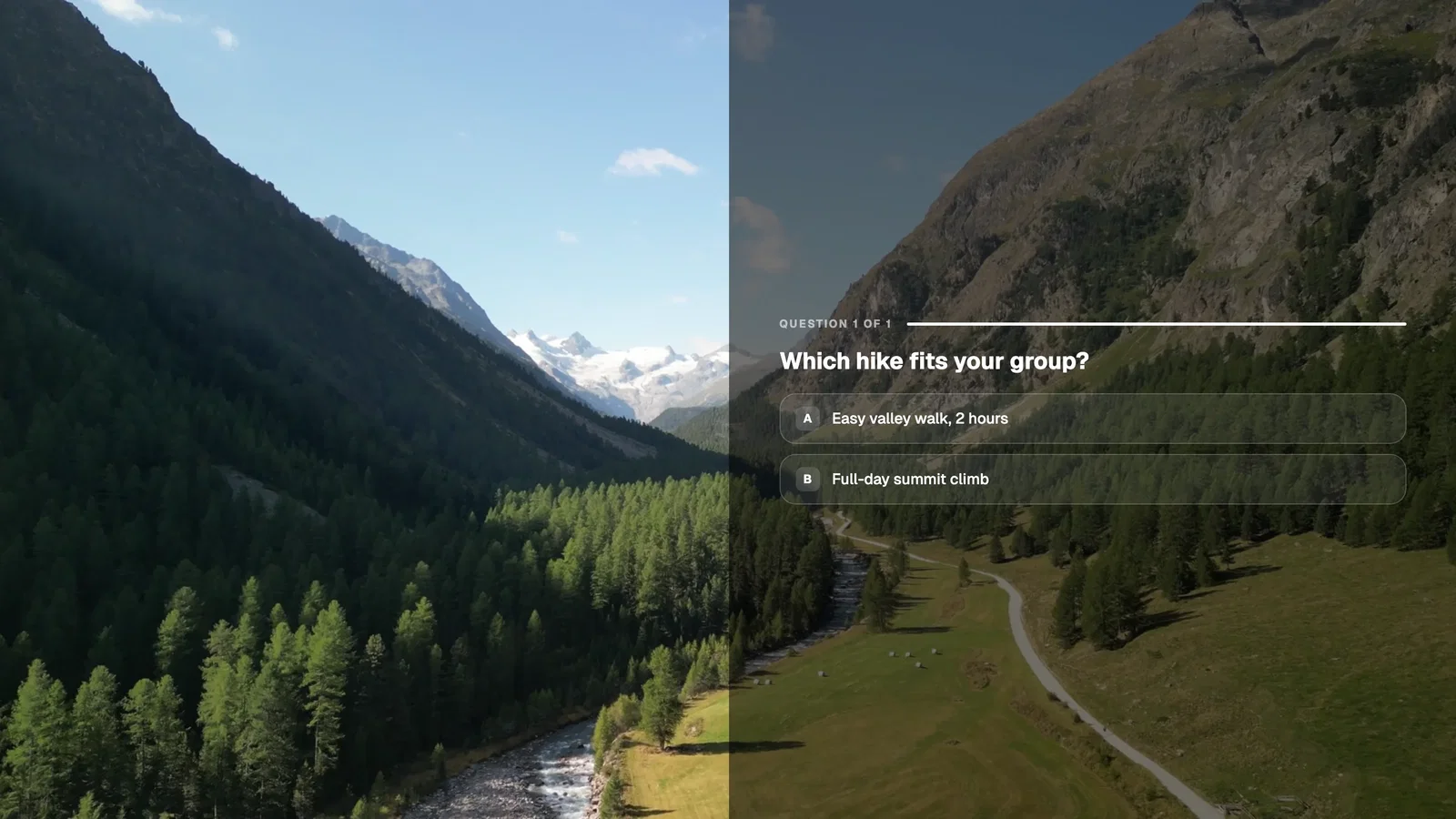
A see-through question lets viewers keep looking at the video frame while they answer. To create one in Mindstamp, open Design for the video, go to the Questions section, keep Panel style on Fill Frame, and lower the opacity of the question Background color in the color picker. Then set Layout to Left, Right, or a custom area so the question covers only the part of the frame the viewer does not need. The other panel style, Floating Card, dims the video and blurs it behind the card, so it does not work for this.
Use a see-through question when the answer depends on something in the frame, such as a gauge reading in a training video or two package designs you want an audience to compare. The hard part is the opacity: too low and the text disappears over bright footage, too high and the question hides the frame. The table below gives starting values.
How to make questions see-through, step by step
1. Choose where the design applies
Question design works at four levels:
- Every video in your account: open Branding in the side menu.
- Every video in a group: open the group's Design page.
- One video: open the video and select Design.
- One question: open the question, go to its Design tab, and switch from Base to Custom. The question then has its own panel style, colors, and layout.
A change on the video overrides the account and group design. If only a few questions sit over important footage, use the one-question option and leave the rest of the video alone. The question and overlay styling guide lists every control in the Questions section.
2. Set the question area with Layout
In the Questions section, Layout has four options. Full covers the whole frame. Left and Right cover half of the frame each, top to bottom. Custom lets you type Left, Top, Width, and Height as percentages of the frame, with a minimum width and height of 20%.
Put the question where the frame has nothing the viewer needs. If the presenter stands on the left and the slide is on the right, choose Left.
3. Keep Panel style on Fill Frame
Fill Frame paints your background color across the whole question area, so a partly transparent color lets the video show through unchanged. Floating Card darkens the question area with a black gradient and puts the question on a frosted card, which blurs the video behind it at any opacity. Choose Fill Frame for see-through questions. Floating Card suits the opposite goal, when you want viewers to stop looking at the video and focus on the question.
4. Lower the background opacity
Under Colors, select the Background swatch. The color picker shows a hex code and a percentage box next to it. The percentage is the opacity: 100% is solid and 0% is fully clear. The default question background is black at 75%. Type a lower number, or drag the slider with the checkerboard pattern. A gradient background works too, and each color stop keeps its own opacity.
The original version of this guide used 10%. That works on dark footage and fails on bright footage, so read the next section before you pick a number.
5. Check the prompt and answer colors
Set the Prompt color in the same row. The Answers color applies to choose-all-that-apply questions. The player checks your prompt color against the background color you picked, treated as if it were solid. If the contrast is below 3:1, the player switches the text to near-black or white. It cannot see the video frame, so a light prompt that passes against a black background can still be hard to read over a bright sky. Check the frame yourself.
The correct and incorrect feedback after an answer has its own Question feedback colors at the bottom of the Questions section. Lower that background's opacity too if the feedback should also be see-through.
6. Preview the question and test it on a phone
The Design page has a live preview. Select the Question chip under it to see the question panel. Then open Preview, play to the question's time, and look at the real frame behind it. Finish with a phone test, because phones change the layout (see below). The guide to publishing and checking a video on mobile covers the test.
How transparent should the question background be?
The prompt sits on a mix of your background color and the frame behind it. The brighter that part of the frame, the more opacity a dark background needs. The WCAG 2.2 accessibility guidelines set a minimum contrast ratio of 4.5:1 for normal text and 3:1 for large text, which WCAG defines as 18 point, or 14 point bold (W3C, Success Criterion 1.4.3). We used the WCAG formula to work out the lowest opacity that meets those ratios for white text on a black background.
| Part of the frame behind the text | Normal text (4.5:1) | Large text (3:1) |
|---|---|---|
| White (255), such as a whiteboard or an overcast sky | 54% | 42% |
| Very light gray (230) | 49% | 36% |
| Light gray (200) | 41% | 26% |
| Medium-light gray (170) | 31% | 13% |
| Mid gray (128) | 8% | 0% |
| Dark gray (90) or darker | 0% | 0% |
To use the table, pause the video at the question's time and find the lightest area behind the prompt and the answers. If the question sits over a bright window or a white slide, start at about 55% and lower it only while the text stays easy to read. Over a dark scene, 10% to 20% keeps the text readable and lets the most footage show through.
The rule works in reverse for a white background with dark text. Over a black area of the frame, a white background needs 46% opacity before black text reaches 4.5:1. A colored area gives about the same result as a gray area of equal brightness, so treat the table as a starting point and check the result on the real frame.
Where to put a see-through question on the timeline
A question pauses the video when it appears, so viewers answer while looking at one still frame. Pick that frame with care:
- Stop on the frame that holds the evidence, such as the label or the chart. You can set the time to a tenth of a second, so move past any frame caught in a camera move or a transition, which pauses as a blur.
- Ask after the narrator finishes the sentence, so the question does not cut off the explanation.
For more on timing and wording, see how to create an interactive video quiz. To choose a question type for the job, see the 13 interactive video question types.
See-through questions on phones
When the player is narrower than 600 pixels, which includes most phones held upright, Mindstamp can show questions as a full-screen panel that is easier to tap. That panel blurs the video behind it. It appears in two cases:
- Use Fullscreen Mobile is on in the Questions section. It is on by default.
- The question area covers the full frame (Layout set to Full).
To keep the frame visible on phones, turn off Use Fullscreen Mobile and use a Left, Right, or Custom area. Check the size before you do. If the player fills a phone screen 375 pixels wide, a half-frame question is about 188 pixels wide, which fits a short prompt with two answers. A long prompt or four answers is easier to read in the full-screen panel, even though it hides the frame.
Keep buttons and hotspots on screen during a question
Buttons and hotspots hide while a question is open. Text and image interactions stay on screen, and a see-through background lets viewers see them. If viewers need a button during the question, for example one that opens a reference image, turn on Show interactions during questions in Settings, under Viewer experience. Active buttons and hotspots then stay visible and clickable while the question is open.
When a hotspot works better than a question
If the answer is a place in the frame, such as "find the frayed cable," any question panel covers part of what the viewer has to search. Put clickable hotspots over the frame instead and give each one a click action. To make the video wait for a click, set the hotspot's pause to At hide time (Require Click), as the guide to requiring a click explains. Each click appears in the viewer's report. Hotspot clicks are recorded as clicks, not as graded answers, so use a question when you need a score.
Common questions
Can I make only one question see-through?
Yes. Open the question, go to its Design tab, and switch from Base to Custom. Set its panel style to Fill Frame, lower its background opacity, and set its layout. A question with a custom design ignores the colors in the Questions section and keeps its own background and text colors in its feedback and in lead capture.
Why did my prompt text change color?
The player changes the prompt to near-black or white when your prompt color has less than 3:1 contrast with your background color. To keep your own color, choose a background color that contrasts with it at full strength, then lower the opacity.
Can the answer buttons be see-through too?
Unselected answers already use a light tint of the text color, so the background shows through them. The selected answer and the Continue button use the Question buttons colors in the Questions section. You can lower the opacity of that button background the same way. Check that the button text stays readable over the frame.
Does a see-through question still pause the video?
Yes. Every question pauses the video when it appears, whatever its design. The background setting changes only how the question looks. See the questions feature page for the question types and how answers appear in reports.
Does this work for survey questions?
Yes. The design settings apply to every question type, including rating, Likert, and free response, so a survey question can sit beside the product it asks about. To build a full survey, see how to create a video survey.
For a first test, set one question to a custom design, put it on the half of the frame with nothing the viewer needs, and start at 50% opacity. Lower the opacity in steps while you watch the paused frame in Preview, and stop at the lowest value where the prompt is still easy to read.