 Brett Lindenberg
Interactive video analytics records what each viewer does inside a video: every answer, click, branch choice, and form entry, tied to that viewer and to the second it happened, alongside watch percentage and drop-off. A standard video report tells you how many people pressed play and where they stopped. Interactive video data adds what they understood and what they chose, so you can fix the section that loses people or follow up with the right lead.
If you are a Mindstamp customer looking for your own reports, sign in at app.mindstamp.com and select Reporting in the left menu.
What interactive video analytics records
A video player can measure watching. An interactive video also creates a record each time a viewer acts on something you placed in it. The table lists each kind of data, what it tells you, and a decision it can support.
| Data | What it tells you | A decision it supports |
|---|---|---|
| Watch percentage | How much of the video each viewer played | Whether a module was watched before you count it as complete |
| Drop-off | The moments where viewers stop watching | Which section to shorten or rewrite first |
| Answers and correctness | What each viewer answered and whether it was right | Which concept to teach again, and which people to coach |
| Participation | The share of questions each viewer answered | Whether viewers took part or skipped the questions |
| Clicks | Which button, hotspot, link, or offer each viewer selected, and when | Which call to action or resource to keep, move, or remove |
| Branch choices | The path each viewer took through the video | Which topic, product, or problem most viewers care about |
| Form entries | Names, emails, and other details viewers submit in the player | Who to follow up with, and what they asked about |
| Variables | Values passed in the link, such as a campaign or team, or saved from an answer | How results differ from one audience to another |
| Device and location | Browser, screen size, and approximate city, region, and country | Whether to test the phone layout first, or which regions to plan for |
Read location as a regional trend. Mindstamp estimates it from the network address unless the viewer agrees to share a precise location, and VPNs, company networks, and mobile carriers often place viewers far from where they sit (Mindstamp Help).
Interactive data exists only where a video gives viewers something to act on. Across 8.07 million views of 18,315 Mindstamp videos (2018 to October 2026), 4,911 videos recorded no viewer actions at all, so their reports could show watching and nothing else.
How Mindstamp organizes the data
Every Mindstamp report is built from three kinds of record. Pick the one that matches your question before you export anything.
| Record | One row is | What it holds |
|---|---|---|
| View | One viewing session | Watched percentage, participation and correctness scores, engagement time, furthest point, device, location, and the page where the video played |
| Interaction | One answer, click, or response | The prompt, the value, whether it was correct, and the time in the video |
| Viewer | One person | Contact details and totals for views, interactions, and watch time across all your videos |
A few definitions matter when you compare numbers (Mindstamp Help):
- Watched percentage counts the unique seconds a viewer played, divided by the video length. Replaying the same minute does not raise it, and skipping to the end does not count the skipped part.
- Engagement time runs from the start of the session to its last activity, so it includes pauses and time spent on questions.
- Participation is the percentage of questions a viewer answered. Correctness is the percentage of answers that were correct. Three answers to five questions is a participation score of 60.
- Furthest point is the latest moment a viewer reached. Last point is where the session ended. They differ when a viewer goes back before leaving (furthest point vs last point).
A session becomes a finished view when the viewer reaches the end, closes the page, or stops for about two minutes. Totals, exports, and integrations use finished views, so a test view takes a few minutes to appear. Playback in the editor preview is not recorded, so test from the share link in a private browser window.
Anonymous and identified viewers
A viewer is anonymous until the video collects or receives a name, email address, phone number, or custom ID. You still see everything an anonymous viewer watched, answered, and clicked. But Mindstamp remembers a viewer only in the browser they watched in, so a new device, another browser, or a private window starts a new viewer record (Mindstamp Help).
To report by person, identify viewers before they watch. Use lead capture, a personalized link, or a URL parameter such as ?email= or ?custom_id=. In an LMS, a SCORM package passes the learner's name and ID to Mindstamp for you.
Where to find each report in Mindstamp
Reporting in the left menu holds the account-wide reports. Each video also has a Reporting tab that opens the same reports filtered to that video. Filter any list by video, group, folder, playlist, or date range.
| Report | What it shows | Use it to |
|---|---|---|
| Views | One row for each session | Check watched percentage and scores, then open a session to see each answer and click with its timecode |
| Interactions | One row for each answer, click, or response | Read every response to one question or button |
| Viewers | One row for each person | See everything one person did across your videos |
| Insights | Totals and charts over time, top videos, top interactions, devices, and countries | Spot a change across a group of videos |
| Questions | The answer breakdown for each question | Find the question most viewers get wrong |
| Exports | Your one-time and recurring exports | Find a file you made earlier, or set up a schedule |
Insights is the summary view. Our guide to the Mindstamp Insights dashboard explains each chart and total, including why its Completion figure is an average and not a completion rate.
Drop-off along the timeline
Each video's Reporting tab has a drop-off graph that shows how many views reached each moment of the video (Mindstamp reporting). Read it next to the interactions on the timeline. A steep fall before a question can mean the explanation before it runs long, and a fall right after a button can mean viewers left through it, which may be the goal. Check the answers and clicks at that point before you change anything.
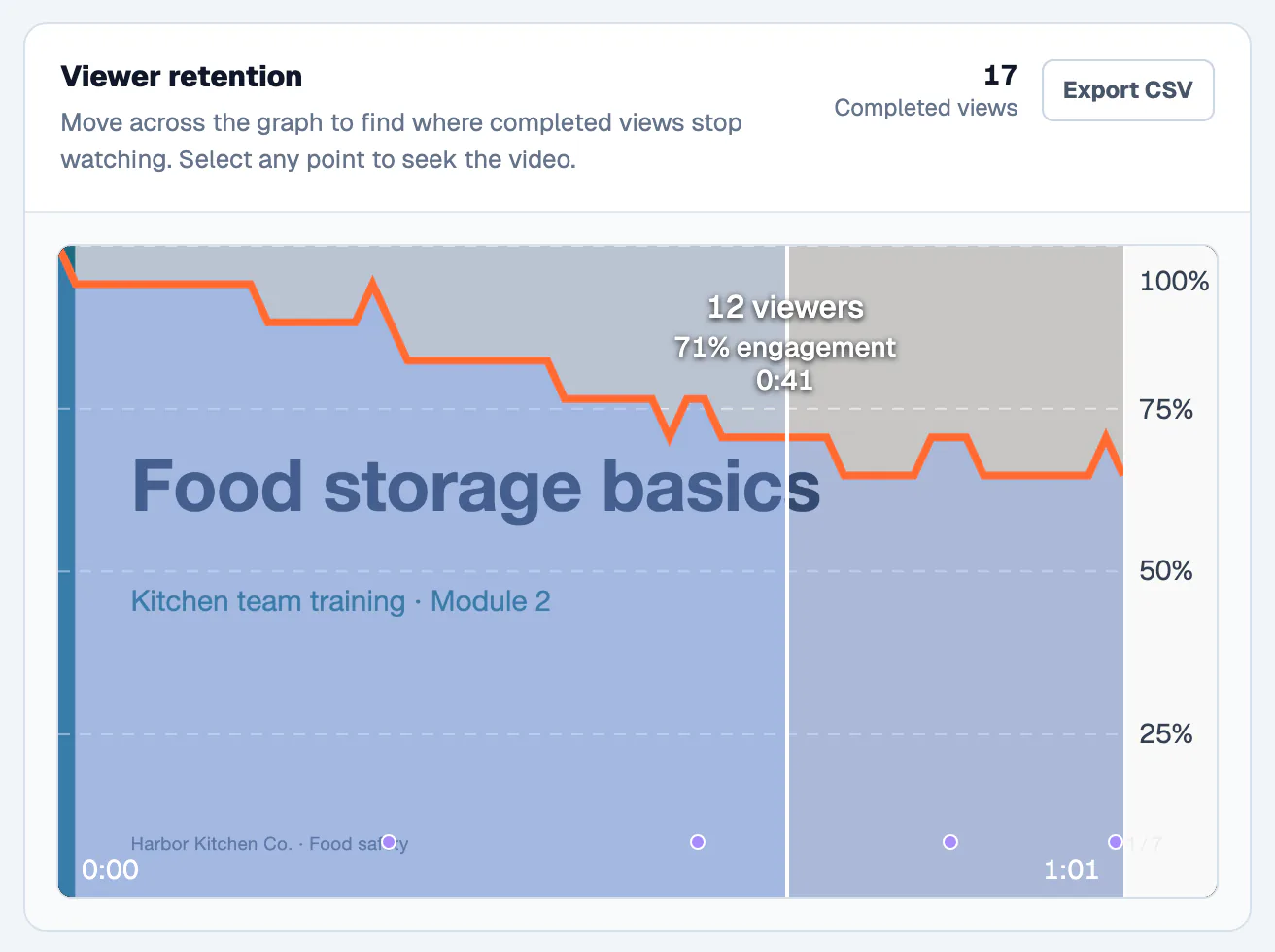
To practice on a pattern like this one, try our drop-off diagnosis example, which asks you to choose the first part of a lesson to inspect.
Branch paths and the branching map
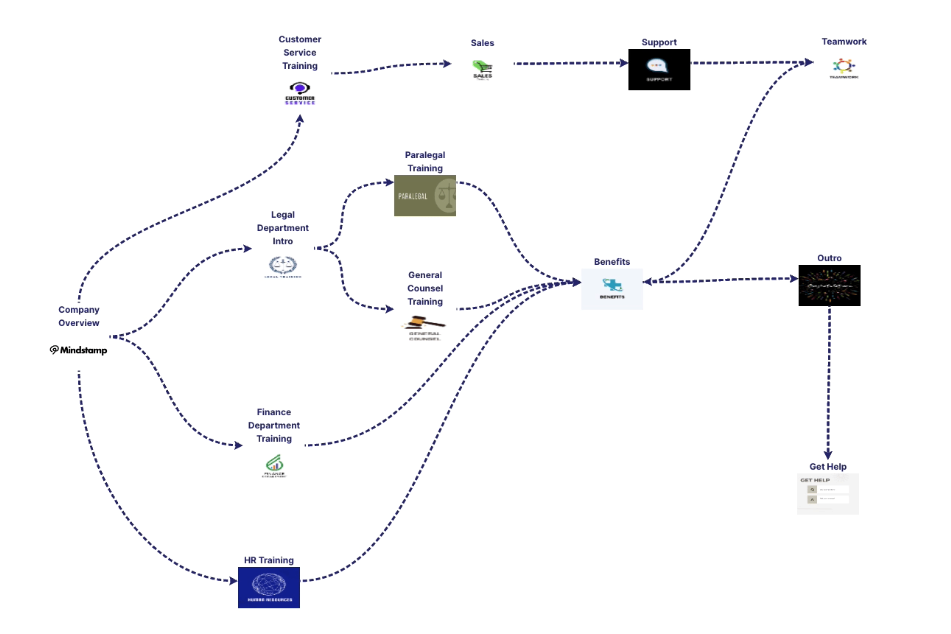
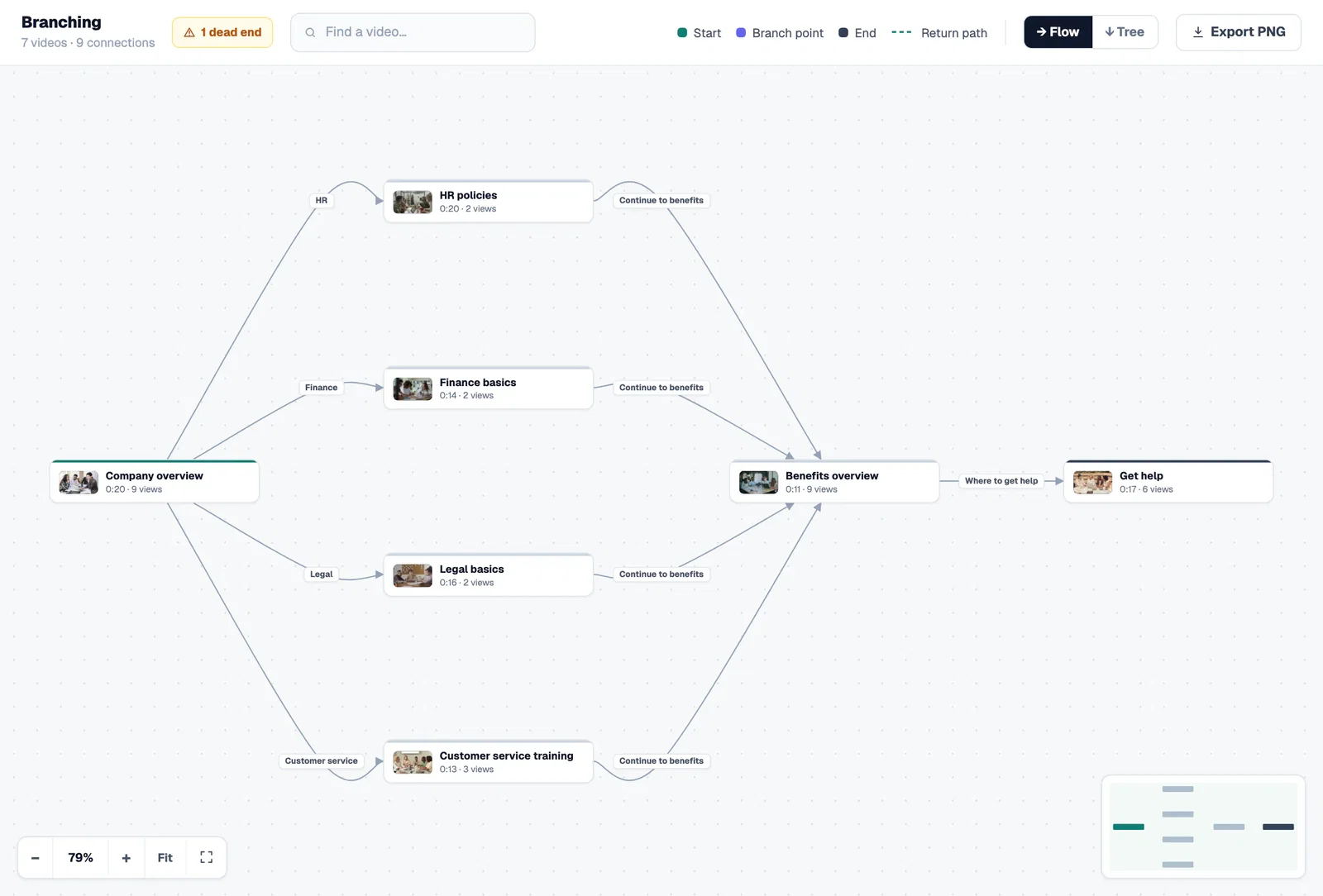
What you see for a branching video depends on how you built it. With Switch Video, each branch is its own video with its own report, so you can see who reached each branch. With Change Time, every branch is a section of one video, and the whole path sits in one view (Mindstamp Help).
To check every route before you share, open More in the video menu and choose See branching. The map shows each video and the switches between them. Our branching visualization tutorial walks through it in under two minutes.
Plan the data before you publish
A report can only answer a question that the video was built to ask. Decide what you need to learn first, then add the interaction that records it.
- Write down the decision the data should inform, for example "Which objection does our demo leave unanswered?" or "Which safety step do new hires get wrong?"
- Put a question, a choice, or a button at the moment in the video that can answer it. A question placed right after the concept it tests shows understanding at that point.
- Decide how you will identify viewers: lead capture, a personalized link, a URL parameter, or a SCORM package in your LMS.
- Pass the audience into the link as a URL parameter, such as ?source=webinar or ?team=support. On supported plans, each view then carries the value as a variable, and you can compare groups (Mindstamp Help).
- Watch your own share link in a private browser window, answer a question, click a button, and check that each action shows up under Reporting.
- Choose the measure you will judge before you look at the results, and wait until each group has enough views. A report with many columns makes it easy to pick whichever number agrees with you.
For the watch metrics themselves, and how to calculate play rate, retention, and completion, see our guide to video engagement metrics.
How teams use interactive video data
The same records answer different questions depending on the job of the video.
| Use | Data to read | What to do with it |
|---|---|---|
| Training and compliance | Correctness for each question, watched percentage, completion report | Coach the learners who missed a concept, rework the step most learners miss, and keep one row per learner for audits |
| Marketing | Clicks on each call to action, form entries, answers split by a source variable | Keep the offer that gets chosen and move or reword the one that does not |
| Sales | The path a prospect chose, clicks on pricing or a calendar, watched percentage | Start the follow-up from what the prospect chose to see |
| Customer support | The choice viewers make at the problem menu, and drop-off on each answer path | Improve the answer for the most common problem first |
For training teams, our guide to video analytics for training shows how to find a knowledge gap step by step and compares the reporting in common training video tools. Our training, marketing, and sales pages show how teams set up each kind of video.
Send interactive video data to other systems
When the data needs to sit next to other records, use one of these routes. Everything except Google Analytics is sent after the viewing session ends, so allow a delay of a few minutes (Mindstamp Help).
| Route | What it carries | When |
|---|---|---|
| CSV export | Views, interactions, or viewers. Up to 25,000 rows in one file, or 5,000 rows with a column for every answer | When you request it |
| Completion report | One row per person, with a score for each video you select | When you request it |
| Recurring export | The same rows, by email or as JSON to a webhook | Daily, on weekdays, weekly, twice a month, or monthly |
| Webhooks | A view record with answers, one record per interaction, or a lead record for each known viewer | After the session ends |
| Zapier | Finished views, known viewers, and interactions | When Zapier next checks, usually within minutes |
| HubSpot | The contact, a view event, the answers and clicks you select, and list changes | After the session ends |
| Google Analytics | Watch-progress events at 10, 25, 50, 75, 90, 95, and 100 percent; no answers, clicks, or contact details | During playback |
| SCORM package | Completion and a score for each learner, sent to your LMS as SCORM 1.2, SCORM 2004 3rd edition, or SCORM 2004 4th edition | When the learner reaches the completion checkpoint |
| REST API | Views with their answers, viewers, and interactions for any set of videos | When your system asks |
| AI assistant through our MCP server | Views, question results, and reports, read by Claude, ChatGPT, or another client you connect | When you ask |
Plans differ by route:
- Google Analytics, view webhooks, Zapier, and SCORM export start on Core.
- Recurring exports, interaction and lead webhooks, HubSpot, and the REST API start on Pro.
- An AI assistant can read your data on paid plans once the account owner turns on AI features (Mindstamp Help).
- Salesforce integration is quoted per account; confirm its scope with Mindstamp (Salesforce integration).
The LMS score and the Mindstamp report score are calculated differently. The SCORM score follows the video's score settings, which choose which questions count and whether the first or the most recent answer counts. The Mindstamp report score counts every attempt and leaves out skipped questions (Mindstamp Help). Tell your LMS administrator before anyone compares the two.
Common questions about interactive video analytics
Which training video platforms track which employees completed a module and answered questions correctly?
You need three things from the platform: a real identity for each employee, results for each question, and a way to get those records into your LMS or a spreadsheet. LMS quizzes usually sit after the video, enterprise video platforms add quizzes to their own hosting, and interactive video platforms such as Mindstamp add questions to video you already host. Our video analytics guide compares what YouTube, Vimeo, Wistia, Panopto, Kaltura, and Mindstamp document about their reporting.
In Mindstamp, the completion report gives one row per learner with a score for each video, a views export adds a column for every question, and a SCORM package sends completion and a score to your LMS. Our help article on tracking a training course covers the setup and a test with one learner.
What is the quickest way to build an assessment video that tracks completion?
Start from a video you already have, so you skip recording. Paste its transcript into our free video quiz generator to draft questions with answers and timestamps, then review them. In Mindstamp, add each question right after the moment that teaches its answer, turn off seeking, and turn on Prevent passing required interactions so learners cannot skip ahead (Mindstamp Help). Identify learners, then export a completion report or upload a SCORM package to your LMS.
Can I see interactive video data in Google Analytics?
Partly. Mindstamp's Google Analytics integration sends watch-progress events to GA4. Answers, clicks, and lead details stay in Mindstamp reports. Use webhooks, Zapier, or the REST API to move those records into another system.
Where can I see interactive video examples?
Our examples page has live interactive videos for training, marketing, sales, and education. Two of them are about reading viewer data: the drop-off diagnosis and read the viewer trail, which compares a route choice, a watch rate, and a view count as follow-up signals.
To start, pick one video that matters this quarter. Write down the decision its data should inform, add one question or choice at the moment that can answer it, identify each viewer, and read the Views report after the first group has watched.