 Brett Lindenberg
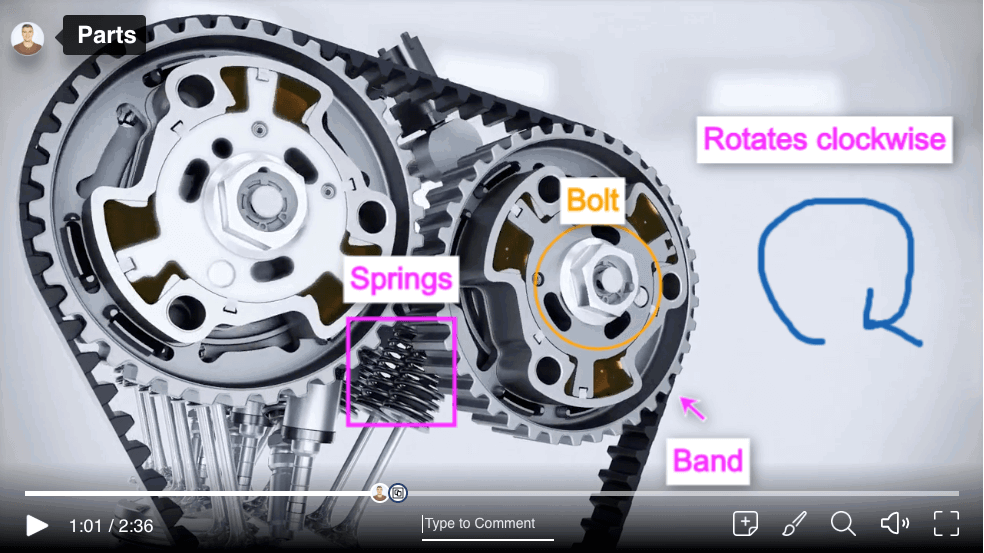
There are three ways to highlight and draw on a video. A video editor such as Final Cut Pro, Kdenlive, or Camtasia burns shapes, arrows, and labels into the file, and every change needs a new export. PowerPoint lets you draw with a pen or highlighter while you record a slide show. An interactive video player shows the marks as a layer on top of the video, so the source file never changes and you can replace a mark at any time. Choose an editor when the video has to play anywhere as a plain file. Choose a layer when the marks will change, or when you want viewers to draw their own answers.
Which method should you use?
The main difference is what happens when a mark needs to change. Burned-in marks are part of the picture. A layer is a separate item you can change without touching the video.
| Method | Changes the video file | To fix a mark | Best for |
|---|---|---|---|
| Video editor (Final Cut Pro, Kdenlive, Camtasia) | Yes. The marks become part of the picture. | Edit the project, export again, and upload the new file | Videos that must play as a plain file on any site or social platform |
| Live ink while recording (PowerPoint) | Yes. The ink is recorded with the slide. | Record the slide again | Slide lessons and walkthroughs you narrate once |
| Interactive layer (Mindstamp) | No. The player shows the marks over the video. | Change the time or pause, or replace the drawing | Training, how-to, and coaching videos you keep updating, and videos where viewers draw an answer |
How to draw on a video in a video editor
Every editor with tracks works the same way. You put a shape, arrow, or text layer on a track above the clip, trim the layer so it covers only the moment it explains, and export.
Final Cut Pro (Mac)
- Choose Window > Go To > Titles and Generators, then open the Elements category.
- Add the Shapes generator to the timeline as a connected clip above the shot you want to mark.
- Select the shape, open the Generator inspector, and choose a shape from the Shape pop-up menu, such as an arrow or a circle.
- Set the fill color, outline color and width, and drop shadow in the same inspector. For a see-through highlight, lower Opacity in the Video inspector.
- Trim the connected clip so the shape shows only while it is relevant.
Apple's guide to adding shapes in Final Cut Pro lists the other shape settings.
Kdenlive (free for Windows, macOS, and Linux)
Kdenlive is a free, open-source editor. Its title editor draws rectangles, ellipses, text, and images, which covers most highlighting jobs.
- In the Project Bin menu, choose Add Title Clip.
- Draw a rectangle (Alt+R) or an ellipse (Alt+E) around the detail, and add a label with the text tool (Alt+T).
- Click Create Title. Kdenlive adds the title clip to the Project Bin.
- Put the title clip on a track above the video. Its shapes and text show over the clips on the tracks below.
These steps follow the title editor chapter of the Kdenlive 26.08 manual.
Camtasia (screen recordings)
Camtasia, from TechSmith, has an Annotations tab built for software videos. It offers six annotation types:
- callouts for text and titles
- Blur & Highlight, to hide one area or make another stand out
- arrows and lines
- sketch motion callouts, which animate as if someone draws them on the screen
- shapes
- keystroke callouts for keyboard shortcuts
You drag an annotation onto the timeline or the canvas, set its start and length on the timeline, and change its color and style in the Properties panel, as TechSmith's annotations tutorial shows.
Burned-in marks are slow to change, because each fix means a new export and a new upload. YouTube Studio's editor can trim a published video without a new upload, but its editing tools cover trimming, blurring, audio, end screens, and info cards, with no drawing or shape tool (YouTube Help, checked October 2026).
How to draw on the screen while you record
If you record a slide lesson, you can draw while you talk. In PowerPoint, open the Record tab and select Record. The tray below the slide holds a laser pointer, colored pens, and highlighters, and PowerPoint records the pen, highlighter, eraser, and laser pointer for playback. When you finish, select Export > Export Video to save a video file. Microsoft's guide to recording a slide show covers PowerPoint 2016 and later and Microsoft 365 on Windows and Mac.
Live ink adds no editing time. To change a mark, though, you have to record the slide again.
How to highlight and draw on a video without re-exporting
An interactive video player shows your marks on top of the video while it plays, so the source file stays as it is. In Mindstamp, a drawing is one of the interactions you place on the video's timeline, next to buttons, hotspots, and questions. It works on a video you upload and on one you already host on Vimeo, Wistia, JW Player, or Kaltura (see which video sources Mindstamp supports). Panopto import is no longer offered, and YouTube links work for testing only.
Add a drawing in Mindstamp
- Open the video, select Interactions, and move the playhead to the frame you want to mark. Pick a frame where the subject is easy to see, because the video stops on it.
- Click More in the interaction bar and choose Drawing under Media. A drawing canvas opens over the frame.
- Pick a tool from the bar at the bottom of the canvas: Draw for freehand lines, Circle to ring a detail, or Text for a label. Use Select to move something you already placed, and the delete button to remove it.
- Click the color swatch to change the color. The pen and circle start in yellow. For a text label, set a background color and a font size that read well over busy footage.
- Under Timing, choose a Pause Length: Until Viewer Click, or 5 to 60 seconds. A new drawing starts at 10 seconds.
- Click Save Drawing, then play from a few seconds before the drawing to check it.
When playback reaches the drawing, the video pauses and the marks appear over the frame. Play resumes when the pause length runs out or when the viewer clicks the frame, so a drawing works like a freeze frame with notes on it. Use it at the moments when you would say "look here": a menu item that is hard to find, the part of a machine the next step uses, or a player's position in game film. The drawings feature page lists more uses.
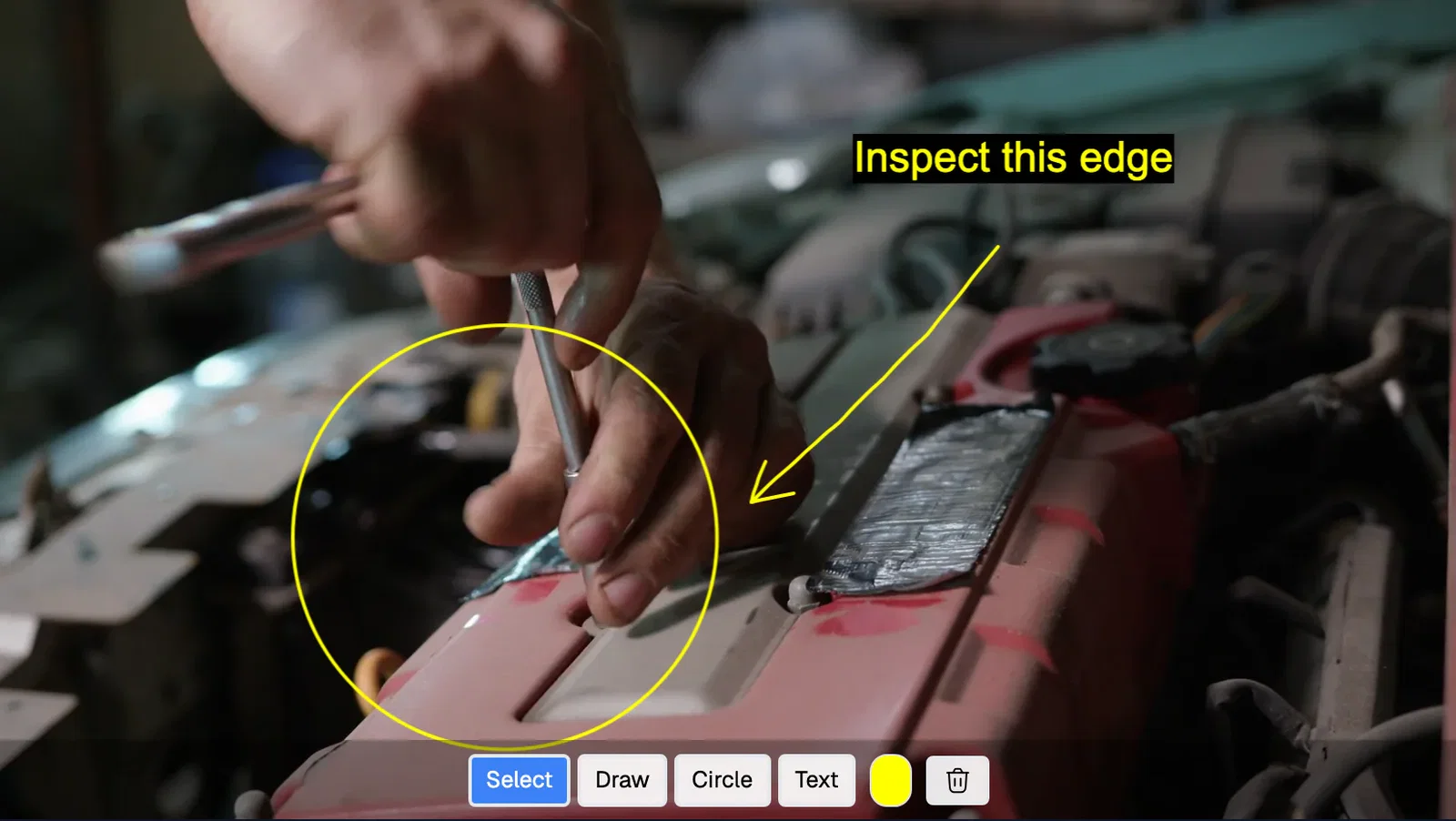
You can change a saved drawing's time and pause length later. To change the marks themselves, delete the drawing and draw a new one. Neither change touches the video file.
Highlight a moving object with a hotspot
A drawing stops the video. When the mark should stay on screen while the video plays, add a hotspot instead. A hotspot puts a colored indicator ring and an optional caption over part of the frame. Under Styling, you can add an Effect such as Pulse, Glow, or Tap to pull the eye to it (on supported plans), and Track motion makes the hotspot follow a moving object. Tracking needs a hotspot that shows for at least 3 seconds and does not pause the video, and it does not work on YouTube videos. A hotspot is also clickable, so the object you highlight can open a link, a detail view, or another part of the video. The hotspot setup guide walks through each setting.
Add a label that stays on screen
For a label that does not stop the video, add a text interaction and set when it shows and hides. Our guide to video overlays covers text and image overlays in more depth.
How to let viewers draw on the video
A Drawing Response question hands the canvas to the viewer. The viewer marks the frame, and the drawing becomes their answer. Use it when the answer is a place, such as "Circle the valve you would close first" or "Mark where the defender should stand." Viewers can draw with a mouse, a finger, or a stylus, depending on the device.
- Add a question at the moment you want to ask.
- Set the type to Drawing Response and write a prompt that names what to mark.
- Decide whether viewers may skip the question.
- Open the share link in a private browser window and submit a test drawing. Owner previews do not store normal viewer responses.
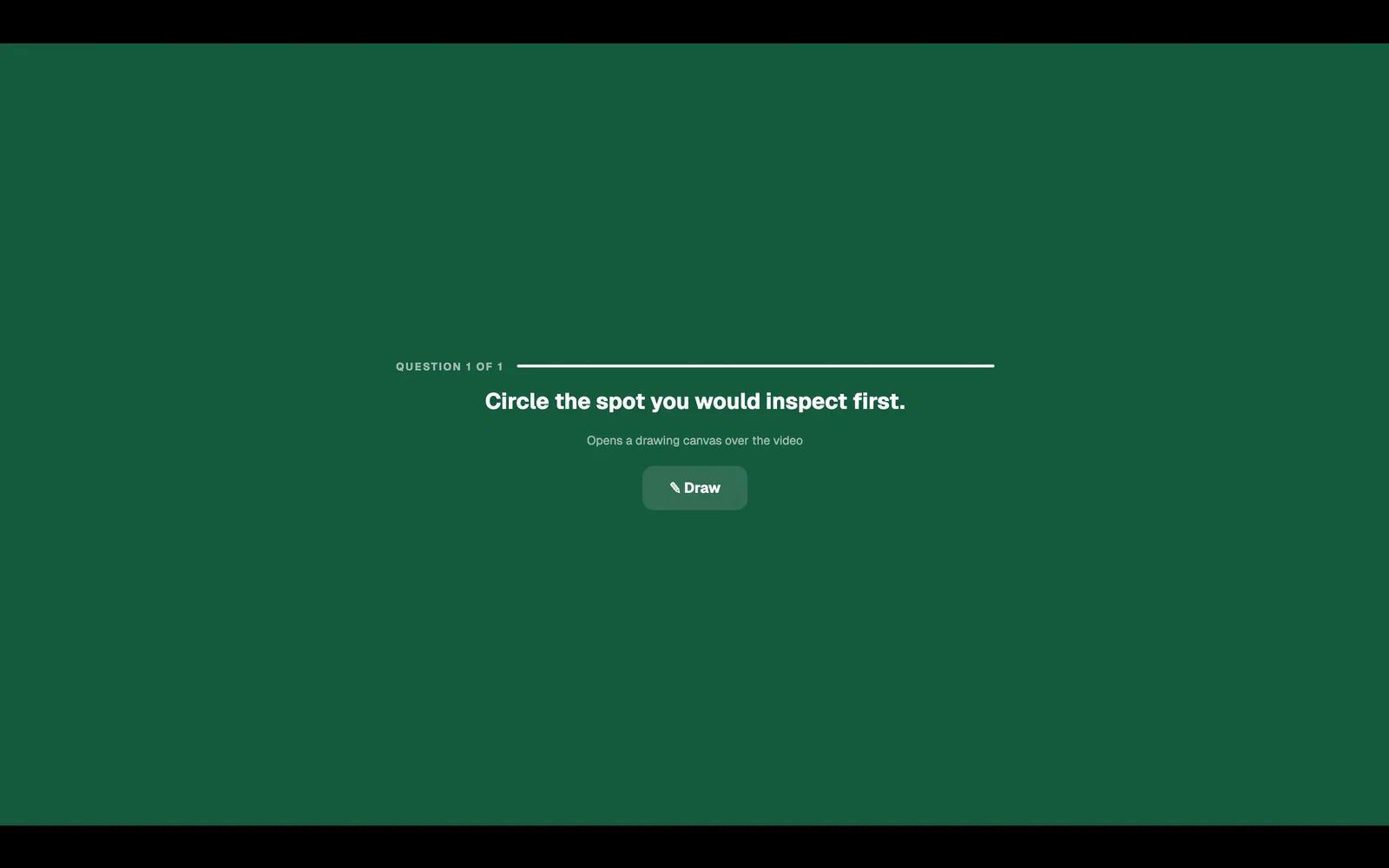
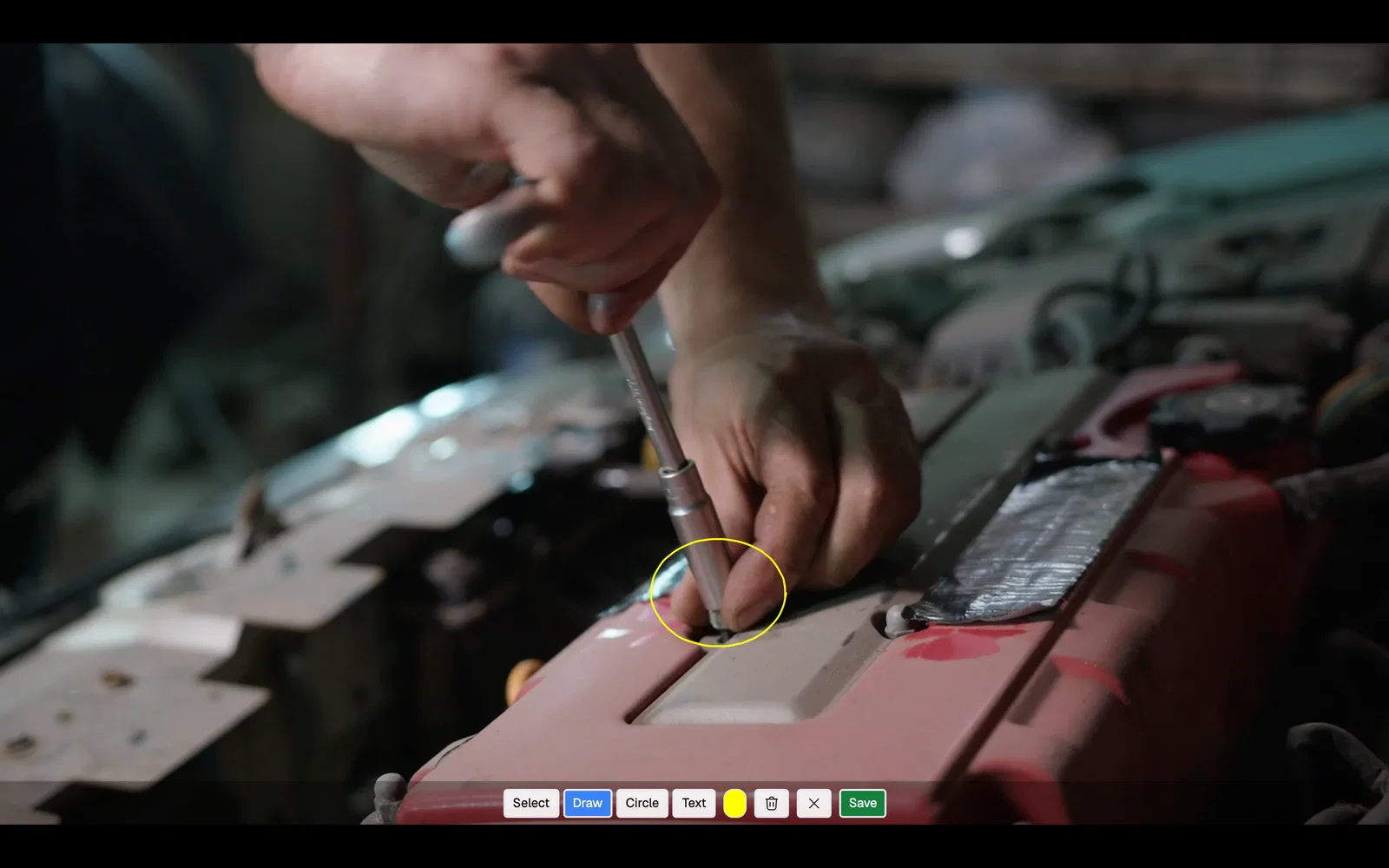
The question pauses the video. The viewer selects Draw, which opens the same canvas over the video, and saves the drawing when done. Each drawing is stored against that viewer as their answer, and you review the answers question by question in your reports. Drawing answers are not scored automatically, so plan to look at them yourself or use them to start a discussion. Mindstamp suggests it for anatomy identification, hazard spotting on a photo of a real site, and art analysis. See drawing responses in education and the drawing question feature page for examples.
Tips for marks that viewers notice and understand
Learning researchers call visual cues like these signaling. A 2020 meta-analysis of 29 experiments with 2,726 participants linked signals to better learning outcomes, with an average effect size of d = 0.38 (Alpizar, Adesope, and Wong, Educational Technology Research and Development). A 2022 overview of 29 meta-analytic reviews put signaling among the design principles with the largest benefits for learning (Noetel and colleagues, Review of Educational Research). A cue helps only when viewers can see it and know what it means:
- Mark one thing at a time. If a frame needs several marks, number them or spread them over separate pauses.
- Check contrast against the footage behind the mark. WCAG 2.2 asks for a contrast ratio of at least 3:1 for graphics that viewers need to understand the content (Success Criterion 1.4.11). The default yellow pen on a white app screen scores about 1.07:1, so switch to a dark color on bright footage.
- Use a word as well as a color. If a red circle means wrong and a green one means right, label them, because color alone fails Success Criterion 1.4.1.
- Leave time to read. The BBC subtitle guidelines plan for 160 to 180 words per minute, or 0.33 to 0.375 seconds per word. A ten-word label takes about 4 seconds to read before the viewer even looks at the mark, so a 5-second pause is too short for long labels.
- Say what you marked. A Mindstamp drawing is an image, and screen readers do not describe what it shows, so name the detail in the narration or the captions too.
- Match the mark to the shot. In an editor, end the shape when the camera moves. In Mindstamp, a drawing holds the frame still, and a tracked hotspot follows an object that moves.
Common questions
Can I draw on a YouTube video?
Not with YouTube's own tools, because YouTube Studio's editor has no drawing tool. If the video is yours, mark up the original file in an editor and upload it again, or put the original file in an interactive player and draw there. Mindstamp accepts YouTube links for testing only, because a YouTube-based video can stop playing without warning.
How can I highlight part of a video for free?
Kdenlive is free and runs on Windows, macOS, Linux, and BSD. Its title editor draws rectangles and ellipses over the video. If you already have PowerPoint and you are recording slides, its highlighter records along with the slide.
Does a drawing change the original video file?
A Mindstamp drawing does not. It is saved as a separate image and shown over the player at its time, so the source file stays the same. Marks from an editor or a PowerPoint recording are part of the picture, and you need a new export to change them.
Can a drawing be clickable?
Clicking a Mindstamp drawing closes it and resumes the video. To make part of the frame open a link or jump to another moment, put a hotspot over it.
Start with one frame: the screen or the part your viewers ask about most. Mark it, publish the video, and see whether the questions about that step drop. To control when the video stops and starts around your marks, read our guide to looping, pausing, and switching a video. Mindstamp is also on X as @UseMindstamp.