 Brett Lindenberg
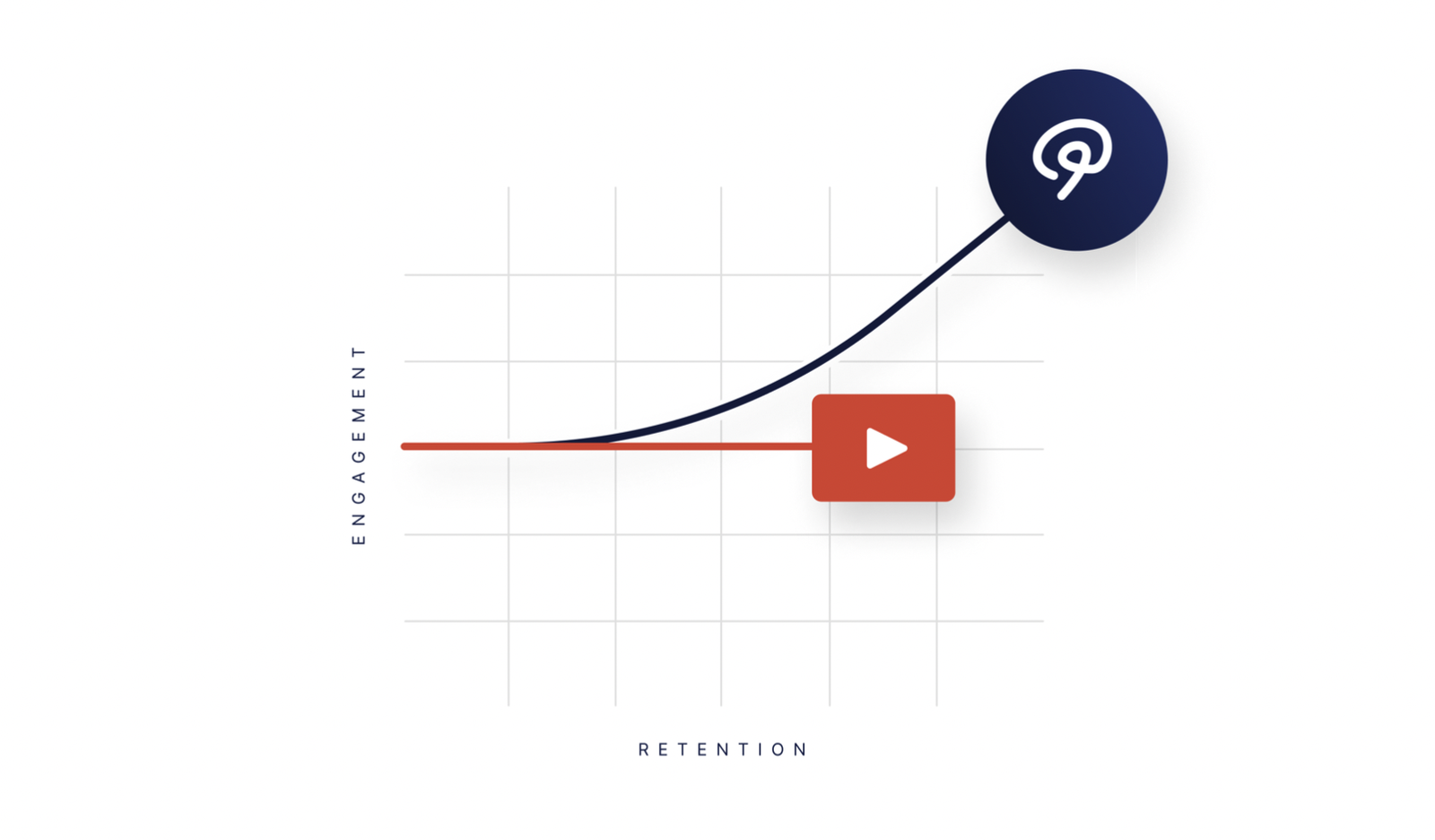
The Mindstamp Insights dashboard shows totals and trends for the interactive videos you choose, including views, watch time, completion, and leads. Open it from Reporting in the left menu, or from any video's Reporting tab to see one video. Use Insights to spot what changed and where, then open the detailed reports to see who did what. We launched Insights in May 2022 and have rebuilt it since, so this guide describes the dashboard as it works in October 2026.
How to open and filter Insights
- Sign in at app.mindstamp.com, open Reporting in the left menu, and select Insights.
- Select Filters and set a date range. To narrow the dashboard, choose one video, a group, a folder, a playlist, or a tag. Each active filter shows as a chip above the dashboard, so you can see what the numbers include.
- To see a single video, open the video, select Reporting, and choose Insights. The dashboard opens filtered to that video.
Insights counts finished views. A session finishes when the viewer reaches the end, closes the page, or stops for about two minutes. Playback in the editor preview is not recorded, so test from the share link in a private browser window (Mindstamp Help).
What each part of the dashboard shows
The six totals
A row of six totals sits at the top of the dashboard.
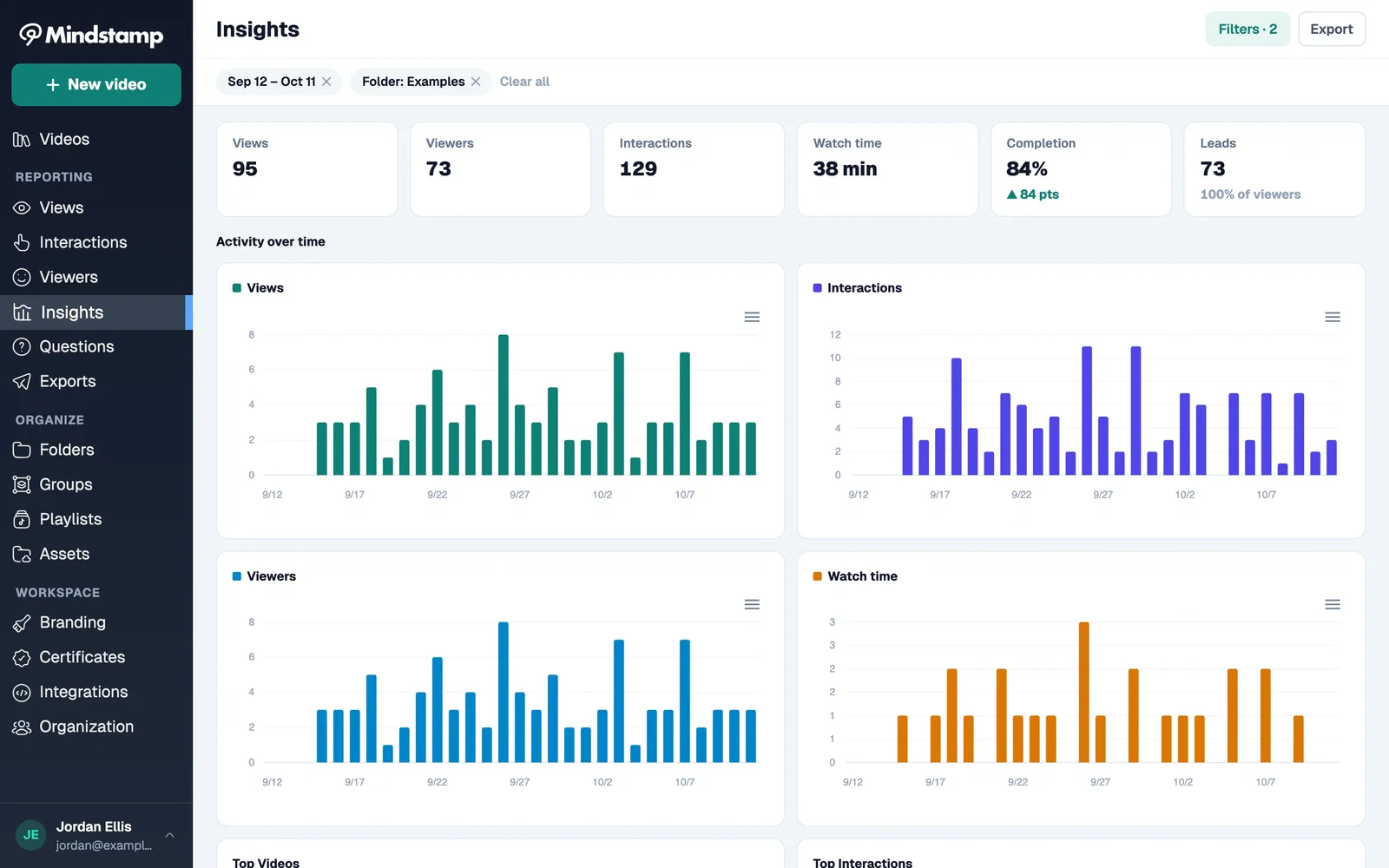
| Total | What it counts |
|---|---|
| Views | Finished viewing sessions |
| Viewers | Distinct viewer records. One person who watches on two devices counts twice unless you identify them. |
| Interactions | Recorded answers, clicks, and responses |
| Watch time | Total video content played, shown in minutes or hours |
| Completion | The average watched percentage across all views. Below 30%, the card adds a note that most viewers drop early. |
| Leads | Viewers with an email address, phone number, or custom ID, and their share of all viewers |
Completion averages how much of the video each view played. A value of 60% can mean every viewer watched about 60% or that some watched all of it and others left early. Watched percentage counts unique seconds played, so replays do not raise it. For one row per learner with a score for each video, export a completion report from Views instead (Mindstamp Help).
The cards for views, viewers, interactions, and watch time also show the change from the period of the same length just before your range, in percent. Completion shows its change in percentage points. A range of the last 30 days compares with the 30 days before it, so set the range before you read a change.
Activity over time
Four charts plot views, interactions, viewers, and watch time across your date range, one point per day. Long ranges switch to one point per month. A gray reference line marks the daily average for the prior period, labeled with its length, such as Prior 30d. A point above the line is a day busier than the prior period's average.
Top videos and top interactions
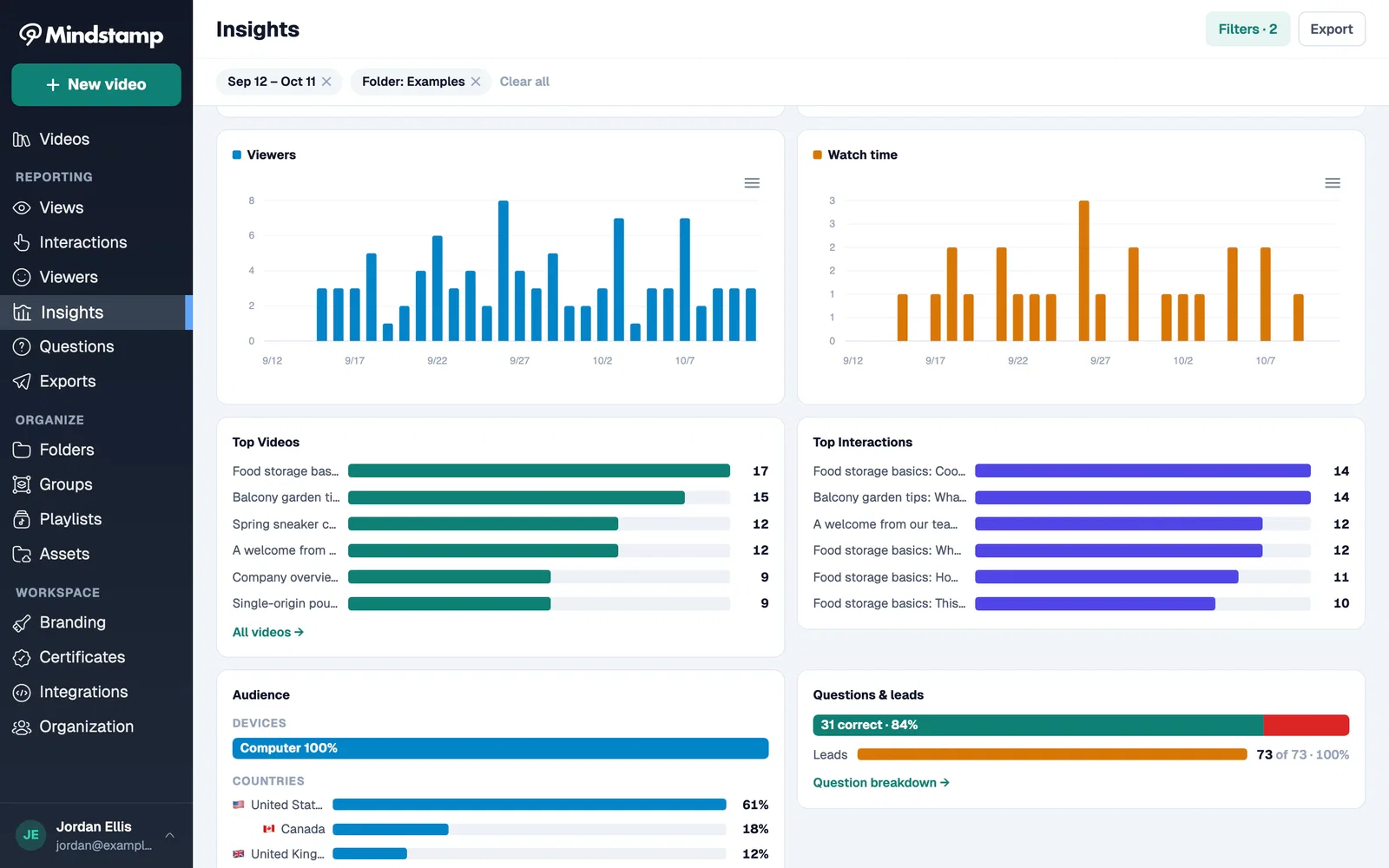
Top Videos ranks up to six videos by views in the range. Top Interactions ranks up to six interactions by how often viewers used them: each answer to a question and each click on a button or hotspot counts once. Compare that list with what the video is for. If a resource link gets more clicks than your main call to action, viewers may want the resource first, or the call to action may appear too late.
Audience
Devices splits views into computer, tablet, and phone by screen width. A screen under 768 pixels wide counts as a phone, 768 to 1,200 pixels as a tablet, and wider screens as a computer. If phones take a large share, preview your interactions on a phone, because buttons and text that fit a laptop can crowd a small screen.
Countries shows the four countries with the most views and groups the rest as Other. Mindstamp estimates location from the network address, and VPNs, company networks, and mobile carriers can place viewers in another city or country, so read the country shares as a trend (Mindstamp Help).
Questions and leads
One bar splits every scored answer in the range into correct and incorrect, with counts and percentages. Below it, Leads shows identified viewers out of all viewers. Select Question breakdown to see how viewers answered each question.
Export and print Insights
Select Export at the top of the dashboard.
- Export Daily CSV, Export Weekly CSV, and Export Monthly CSV each download one row per period, with views, interactions, viewers, streaming minutes, completion, and leads for your current filters.
- Print opens a dialog where you choose the charts and a layout. Classic prints the original chart set, and Dashboard prints the page as it looks on screen. To share a PDF, choose Save as PDF in your browser's print dialog.
Insights exports hold totals only. For one row per session, answer, or person, export from Views, Interactions, or Viewers (Mindstamp Help). On Pro and higher plans, a recurring export can email those files every day, week, or month.
Use Insights to decide what to look at next
Use the dashboard to find the change, then follow it to the report that explains it:
| What you see | What to check | Where to check it |
|---|---|---|
| Views rise and completion falls | Whether new viewers come from a different page or audience | Views, filtered to the recent dates, with the page URL of each session |
| Completion is low on one video | The moment most viewers stop | The drop-off graph in that video's Reporting tab |
| Interactions stay flat while views grow | Whether new viewers reach the first interaction, or miss it on a phone | The drop-off graph, then the Devices panel |
| A large share of answers is incorrect | Which question most viewers miss, and whether the question or the lesson is unclear | Question breakdown |
| Leads are a small share of viewers | Whether the lead capture form appears, and when | The video's Lead capture settings, then Viewers |
| A launch or campaign just ended | How the campaign period compares with the period before | Insights, with the date range set to the campaign weeks |
To compare audiences, filter by group or playlist. On supported plans you can also pass a value such as ?source=webinar in each link and filter Views by that variable (Mindstamp Help). For the metric definitions behind these checks, see our guide to video engagement metrics.
What Insights does not show
- Individual viewers. Open Views or Viewers to see who watched and what each person answered and clicked.
- Drop-off inside a video. Open the video's Reporting tab for its retention graph.
- Engagement time and region. Export Views to get both.
- Sessions still in progress, and your own plays in the editor preview.
For how views, interactions, and viewers fit together, and how to send them to your LMS or CRM, read our guide to interactive video analytics.
What changed since the 2022 launch
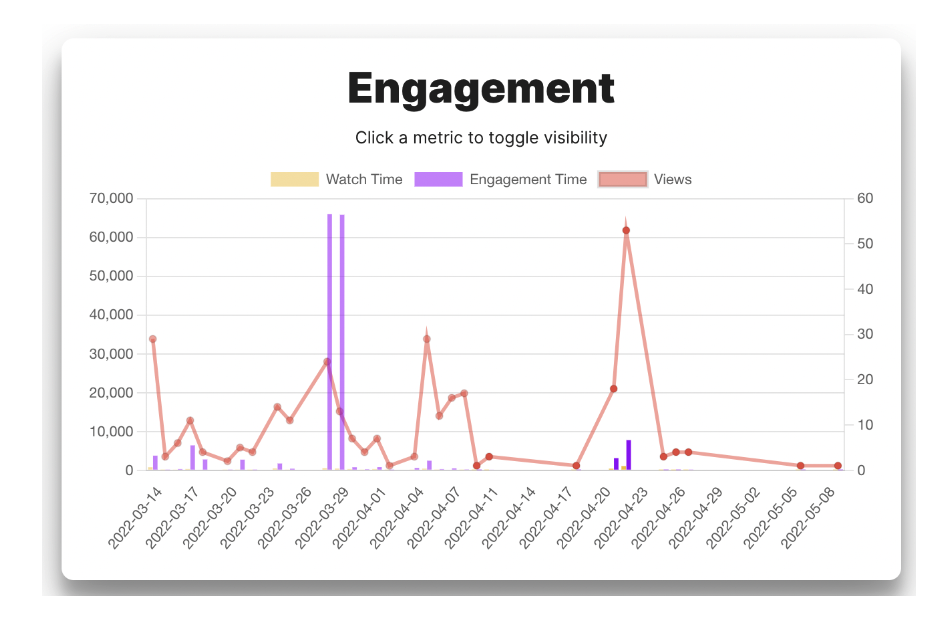
The first version of Insights, launched in May 2022, had four charts (Engagement, Completion, Interactions, and Geography) and two tables (Top Videos and Top Interactions). You could filter by video, date, playlist, or group. The Engagement chart showed watch time, engagement time, and views together, and the Geography map let you drill into states in the United States.
The current dashboard keeps top videos and top interactions and adds:
- A row of six totals, with the change from the prior period
- Separate charts over time, with a prior-period reference line
- Device and country shares, question results, and leads
- Folder and tag filters
- Daily, weekly, and monthly CSV exports and a print layout
Engagement time and the state map are no longer on the dashboard. Both engagement time and region are columns in the Views export.
Common questions about Mindstamp Insights
What is the difference between watch time and engagement time?
Watch time is the video content a viewer played. Engagement time runs from the start of the session to its last activity, so it also includes pauses and time spent answering questions. Insights shows watch time. Engagement time is a column in the Views export (Mindstamp Help).
Do views from my LMS appear in Insights?
Yes. A Mindstamp SCORM package loads your hosted video inside the LMS, so those views appear in Mindstamp reports and count toward your plan's streaming minutes (Mindstamp Help).
Can I give a client access to reports for their videos only?
Yes. Put the client's videos in a group and invite the client to that group with the Analyst role. They see the reports for that group only and do not use an admin seat. Groups start on the Core plan (Mindstamp Help).
Can I get Insights data through the API or an AI assistant?
The Mindstamp REST API has endpoints for account insights and for a single video's insights, on Pro and higher plans. On paid plans, an AI assistant connected through our MCP server can also read your reports once the account owner turns on AI features (Mindstamp Help).
Which plans include Insights?
Every plan includes Insights and the drop-off graph for each video. Recurring exports and the REST API start on the Pro plan. Our pricing page has the full plan table.
Why do Insights numbers differ from Google Analytics?
The two tools count different events. Insights counts finished Mindstamp views. Google Analytics receives a page view when the player loads, then one event at each watch-progress milestone (Mindstamp Help). Compare trends between the two, not exact totals.
To start, open Insights, set the range to the last 30 days, and find the total that changed most from the prior period. The table above names the report to open for that change.