 Brett Lindenberg
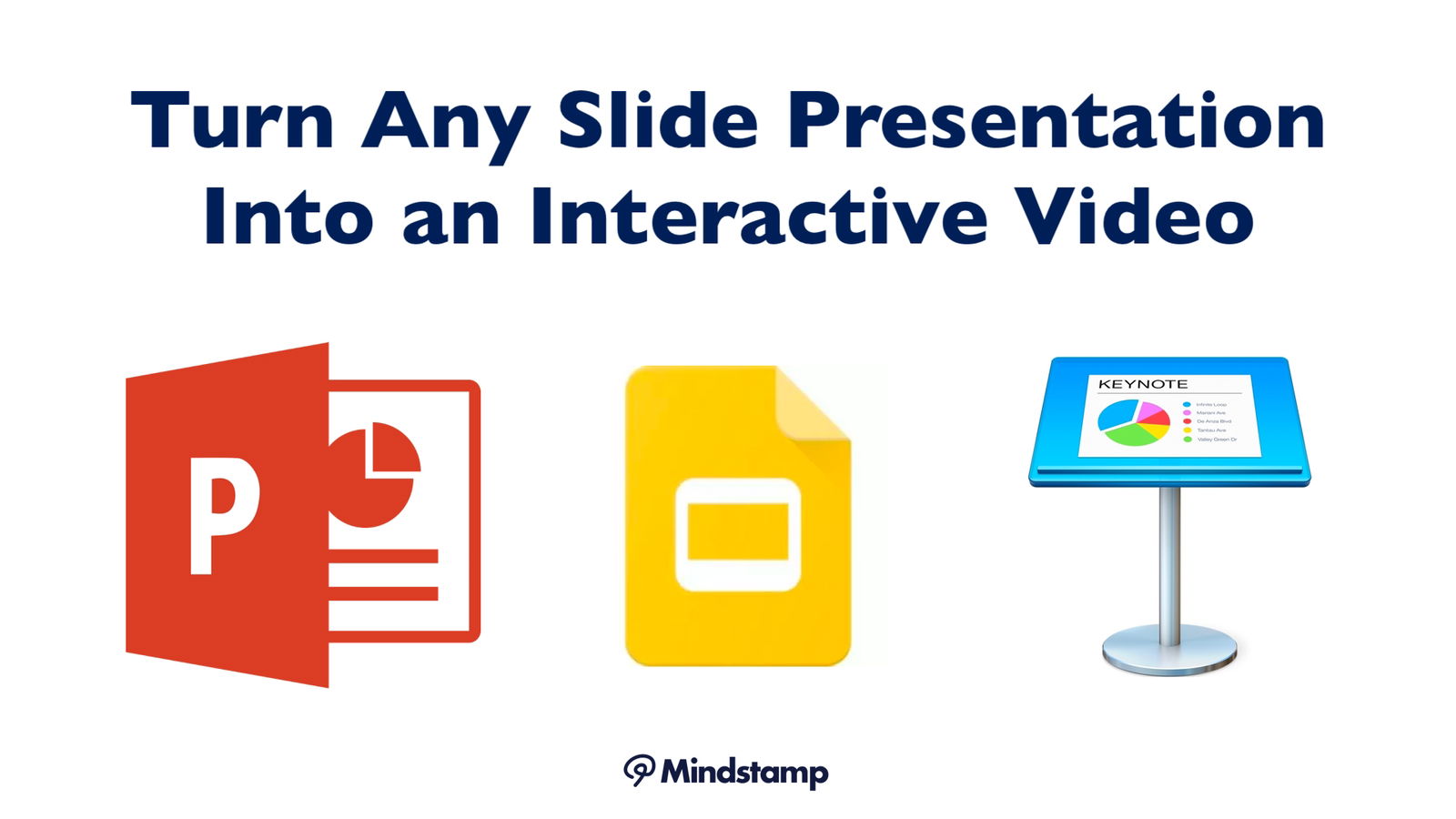
To turn a PowerPoint, Keynote, or Google Slides presentation into an interactive video, save the deck as a video file, upload the file to an interactive video tool such as Mindstamp, and add questions, buttons, and hotspots at the moments where viewers should respond. Then share the link or embed code and read each viewer's answers in the report. In PowerPoint, the export starts at File > Export > Create a Video. In Keynote, it is File > Export To > Movie. Google Slides needs a recording, a conversion in Google Vids, or a download to PowerPoint first. The steps below cover each app in detail, then show where each interaction belongs on a slide video and how to set it up for training or sales.
What an interactive video presentation adds
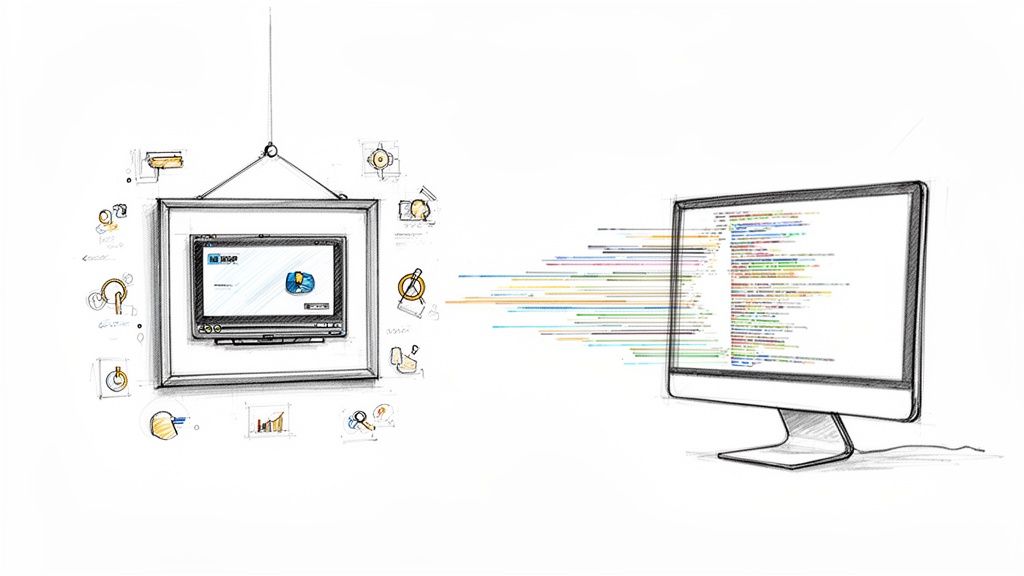
A deck saved as a video plays straight through. Links, action buttons, and quiz slides stop working, because a video file cannot take a click. An interactive video presentation puts those parts back on top of the video. A question pauses playback until the viewer answers, and a button can jump to the section the viewer picks. Mindstamp saves each answer and click against the viewer who made it, so the report shows what each viewer answered and how far they watched.
This guide is about recorded presentations that people watch on their own time. For a live talk in a room or on a call, see how to make a presentation interactive and our list of interactive presentation ideas. To see a finished slide video, play the interactive presentation example, where each choice on a quarterly review slide opens a different interaction.
Step 1: Save your presentation as a video
Get the deck ready before you export
- Mark the slides where viewers should do something, such as answer a question or pick a section. You will add those interactions in Step 2, so the slides themselves need no quiz buttons.
- Record narration if you can. Without it, PowerPoint shows each slide for the same time (5 seconds by default) unless you set a time for each slide, and 5 seconds is too short for most text-heavy slides. A narrated video can also get a transcript in Mindstamp, which can draft quiz questions from it.
- For a choice between sections, add a slide that shows each option as a large box. In Mindstamp, you place a clickable hotspot over each box.
- Delete "click here" text and in-deck links. Viewers will try to click them, and nothing happens in a video. Rebuild them as buttons in Step 2.
- Finish the content first. Mindstamp does not trim or join video files (see trimming and combining clips), so set slide timings in your slide app.
| App | Where to start | Narration | Watch out for |
|---|---|---|---|
| PowerPoint for Windows | File > Export > Create a Video | Record tab, then export with recorded timings and narrations | Long decks can take hours to export |
| PowerPoint for Mac | File > Export, then MP4 or MOV | Record in Slide Show, then export with recorded timings and narrations | Animation effects and embedded media do not play in the movie |
| Keynote for Mac | File > Export To > Movie | Play > Record Slideshow, then choose Slideshow Recording | Set slide and build timings for a self-playing export |
| Google Slides | The Rec button, or File > Convert to Video in Google Vids | Record in Chrome or Edge, or use speaker notes as the script in Vids | Not every Google account has these features |
| Any app | A screen recording of the slide show | Depends on the recorder; the Mac Screenshot app can record a microphone | The video shows exactly what is on screen, including mistakes |
Record narration in PowerPoint first
In PowerPoint for Microsoft 365, select Record on the Record tab. Your speaker notes appear at the top of the screen as a teleprompter, and you can turn the camera and microphone on or off. Narration does not record during slide transitions, so let each transition finish before you speak. When you are done, select Export > Export Video. Microsoft's guide to recording a slide show covers older versions and the Mac app. PowerPoint for the web cannot record a slide show.
Export from PowerPoint for Windows
- Save the presentation as a .pptx file.
- Select File > Export > Create a Video, or Export to Video on the Recording tab.
- Choose the quality: Ultra HD (4K) at 3840 x 2160, Full HD (1080p) at 1920 x 1080, HD (720p) at 1280 x 720, or Standard (480p) at 852 x 480. Higher quality makes a larger file, and the 4K option needs Windows 10 or later.
- If you recorded narration, keep Use Recorded Timings and Narrations. If not, set Seconds to spend on each slide.
- Select Create Video, choose MPEG-4 Video as the file type, and save.
The video keeps animations, transitions, and embedded video. According to Microsoft's export guide, a long or complex deck can take several hours to export, and you can keep working in PowerPoint while it runs. The export leaves out QuickTime media, macros, and OLE or ActiveX controls. It also drops media inserted in old versions of PowerPoint unless you convert the file first with File > Info > Convert.
Export from PowerPoint for Mac
Select File > Export (Save As has no video options), open File Format, and choose MP4 or MOV. Pick a quality from Ultra HD (4K) down to Standard (480p), check Use Recorded Timings and Narrations or set the time for each slide, and select Export. Microsoft's Mac export page lists limits that matter for a slide video: narration recorded in Slide Show plays, but other embedded media files do not, animation effects do not play at all, and some transitions play differently. Recorded narration is included from version 16.19. If a deck depends on animations or video clips, export it from PowerPoint for Windows instead.
Export from Keynote
- To add your voice, choose Play > Record Slideshow, click the record button, and present. Keynote saves the recording with the presentation.
- Choose File > Export To > Movie.
- In the Playback menu, choose Slideshow Recording to include your narration, or Self-Playing to advance slides and builds at the time intervals you enter. You can also export a range of slides.
- Choose a Resolution, or Custom for your own size. Advanced Options sets the frame rate and movie format.
- Click Save, name the file, choose a location, and click Export.
Apple's steps are in the Keynote guides to exporting to another format and recording presentations.
Turn Google Slides into a video
Google Slides has three ways to make a video, and two of them depend on your account.
- To record in Slides, select Rec > Record new video, then the red record button, and save the result to Drive. Google's Slides recording guide says recording works only in Chrome and Edge, may be limited to certain work or school accounts, and stops at 30 minutes per recording. Recordings go to a My Drive folder named Slides recordings. Download the file from there, or import it into Mindstamp straight from Drive (see Step 2).
- To convert the deck in Google Vids, select File > Convert to Video. This needs an eligible Google Workspace subscription. Each slide becomes a scene of 5 seconds, or as long as its voiceover if you have Gemini write a script from your slides and speaker notes. Google's conversion guide sets limits of 100 slides (45 with the AI script and voiceover) and 10 minutes of video, and it does not bring over word art or video files. In Vids, select File > Download as MP4.
- To use PowerPoint instead, select File > Download, choose the PowerPoint (.pptx) format, and export the file from PowerPoint as above. Play the downloaded deck once in PowerPoint before you export it.
If none of these fit, present the deck full screen and record the screen. On a Mac, press Shift-Command-5, choose a microphone under Options, and select Record Entire Screen (Apple's steps). On Windows, open Snipping Tool, select Record > New (or press Windows logo key + Shift + R), select the area, and select Start (Microsoft's steps).
Step 2: Upload the video to Mindstamp and add interactions
Upload the file
In Mindstamp, select New video, then Upload, and drop in the file. The upload accepts common formats such as MP4, MOV, and WebM, and the editor opens as soon as the upload starts. The maximum file size depends on your plan and shows under the upload box (see video length and file size). If a 4K export is too large, export again at Full HD (1080p), or save an MP4 with H.264 video and AAC audio (see how to compress a video). Mindstamp hosts the upload and streams it at a quality that suits each viewer's connection. If the video is in Google Drive, you can skip the download: select Google Drive instead of Upload, connect your Google account the first time, and pick the file in Google's file picker.
Match each part of the deck to an interaction
Most interactive parts of a slide deck have a direct replacement in the video. Add each one at the right moment on the timeline, which is precise to one tenth of a second.
| In the slide deck | In the Mindstamp video |
|---|---|
| A quiz or knowledge-check slide | A question, such as multiple choice or free response. The video pauses until the viewer answers. |
| A live poll | A Display Poll question, which shows a chart of how all viewers answered |
| A hyperlink to a web page | A button with the Open link action |
| An agenda slide or action buttons that jump between sections | Buttons with the Change Time action, plus chapters in the progress bar |
| A diagram or chart people should explore | A hotspot over each part, which opens a message, an image, or a link |
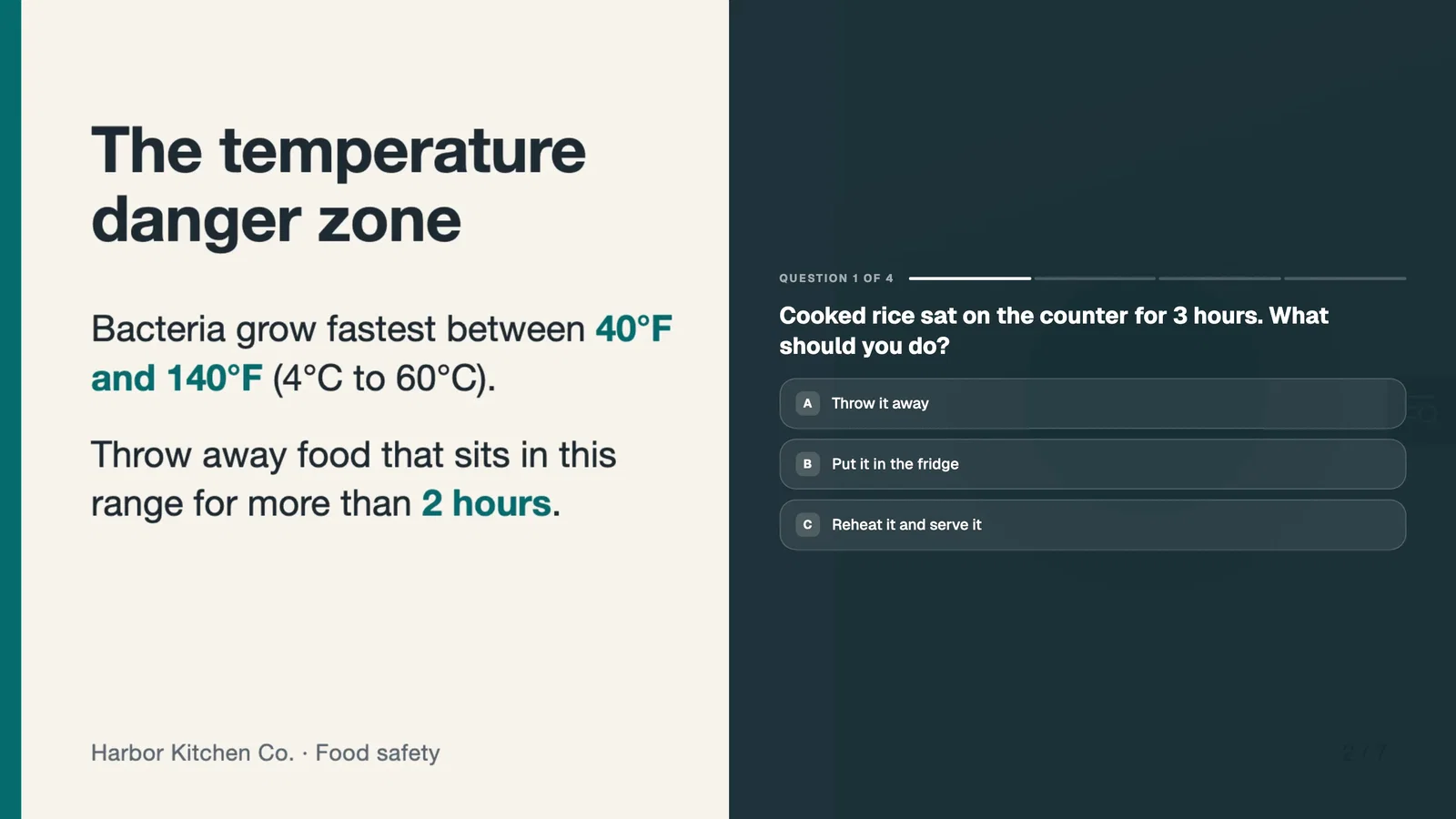
| A trigger that reveals the answer on click | A multiple-choice question with a Show Message action for each answer |
| "Which topic next?" slide | Buttons or hotspots that use branching to send each viewer to the section they chose |
The question setup guide lists all 13 question types and the settings for each one.
Place questions where the slide makes its point
Put each question at the end of the slide that teaches the point, after the narration finishes and before the transition. The question pauses the video, so you do not need to add extra time to the slide. Ask an easy question in the first minute so viewers learn how the video works. For a wrong answer, use the Change Time action to send the viewer back to the start of that slide.
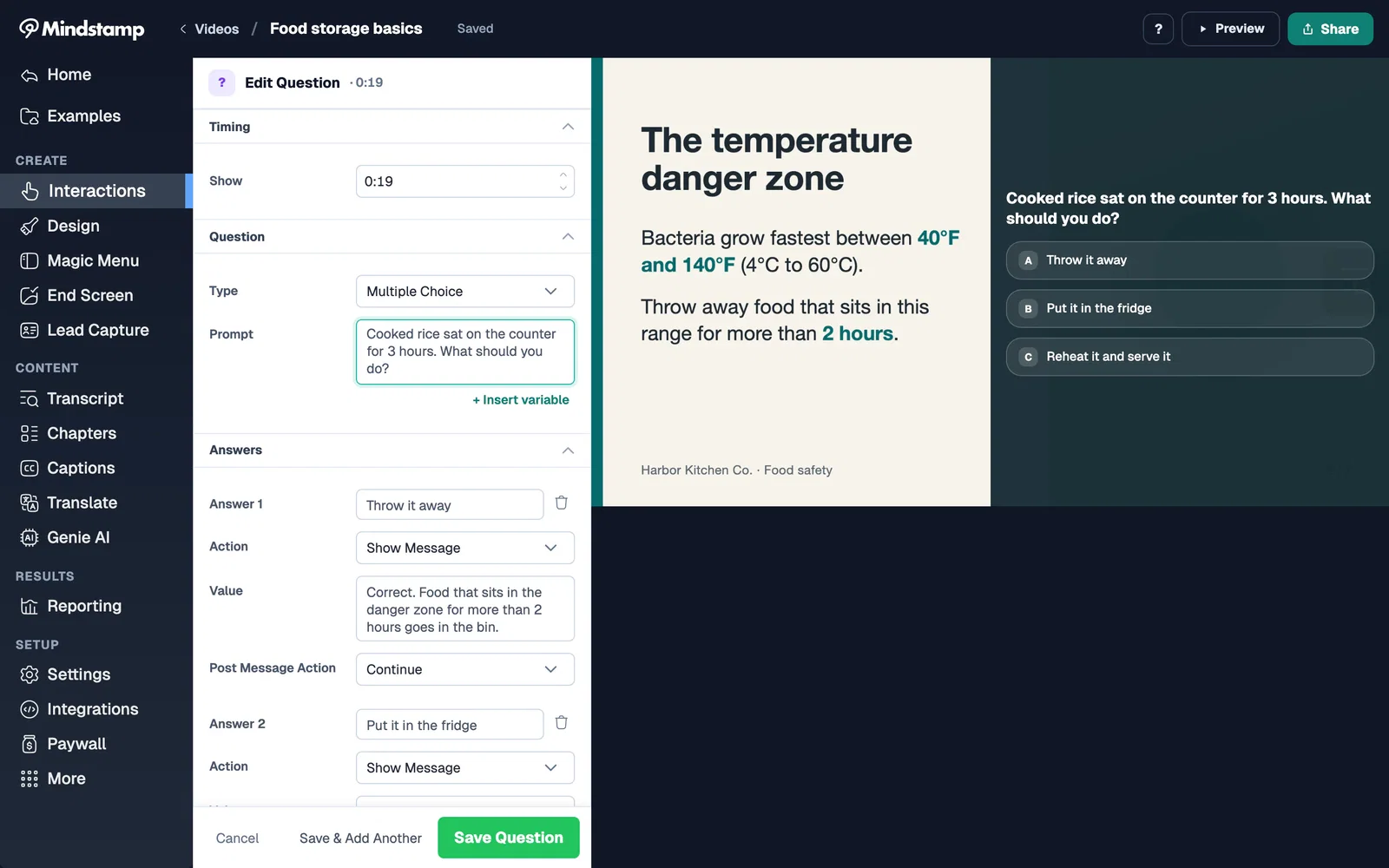
If you narrated the deck, open Transcript and select Create Transcript. When you add the first question, Mindstamp offers to generate multiple-choice questions from the transcript, spaced through the video (see how transcripts work). Read every suggestion against your slides before you keep it.
Match the player to your slides
Use Design to set the colors and fonts of buttons, questions, and the player, so the interactions look like part of your deck (branding options). If you change slides later, select More > Replace source video and upload the new export. Your interactions, settings, share link, and embed code stay the same. Play the new version once and move any interaction whose slide moved, and create a new transcript if the narration changed (replacing a video file).
Step 3: Share the video and read the results
Publish the video and open Share. Copy the link for an email or a chat, or download a QR code for print. To put the video on a web page, choose Responsive, Popout, or Basic iframe and copy the embed code. Edits you make later do not change the link. Before you send it, open the link in a private browser window where you are not signed in and try every interaction. Mindstamp does not record your previews in the editor as viewer sessions (sharing options).
The reports show one row for each viewing session, with the share of the video watched, the scores, and every answer and click with its time. The Questions page shows how all viewers answered each question, and every list exports to CSV (reading reports). Viewers are anonymous until you collect their identity, for example with lead capture at the start or a personalized link.
A long deck can work better as a few shorter videos. Across 8.07 million views of 18,315 Mindstamp videos (2018 to October 2026), the average view of a video longer than 20 minutes played 41.7% of it, compared with 53.8% for videos of 10 to 20 minutes. These are Mindstamp videos, mostly training, marketing, and sales content, and many factors differ between them, so treat the gap as a pattern, not a benchmark. If you keep one long video, add chapters so viewers can go straight to the section they need.
How to make PowerPoint training interactive and trackable
A narrated slide video with questions can replace a classroom PowerPoint session, as long as each learner's progress and score are recorded. Set it up this way:
- Identify each learner. If you deliver through an LMS, a SCORM 1.2 or 2004 package from the Share page passes the learner's name and LMS ID to Mindstamp, and it is available on supported plans (SCORM export). Outside an LMS, use lead capture or add
?email=to each learner's link. - Set a correct answer on each knowledge-check question. Turn on Repeat Until Correct if learners should try again until they get it right (scores and retries).
- Stop skipping ahead. Turn off Allow Seeking in Design, turn off Allow skipping on each required question, and turn on Prevent passing required interactions in Settings on supported plans (how to stop learners skipping).
- In the SCORM package, choose a completion checkpoint: 10%, 25%, 50%, 75%, 90%, 95%, or 100% of the video. The LMS then records completion and a score. The score follows the video's score settings: All questions or Answered questions only, and the first or the most recent answer.
- If the course has several decks, put the videos in one playlist and export a completion report, which gives one row per learner with a score for each video (tracking a training course).
Test the whole course as a learner before launch: answer one question wrong, finish the video, and check that the report and the LMS show the result. Our training page and the video quiz example show the same setup in a finished course.
Turn a sales deck into an interactive video for prospects
Account executives often send a pitch deck after a call and then wait. A recorded deck with interactions shows which sections each prospect opened and what they answered, before the follow-up.
- Open with one discovery question, such as team size or main goal, and branch each answer to the slides that fit it.
- Show the prospect's name or company on screen from a personalized link, on supported plans (personalization).
- After the pricing slides, open a Calendly or HubSpot calendar inside the player so the prospect can book a meeting without leaving the video (calendar embedding).
- Read the viewer report before you call to see which sections they watched twice and which buttons they clicked.
When you compare tools for this job, check four things: a report for each person who watched, booking inside the player, personalization from a link or your CRM, and a way to send answers to your CRM. Our proposal walkthrough use case and sales page show how a deck becomes a guided video.
Common questions
How do I turn a slideshow into a video?
Use the export built into your slide app: File > Export > Create a Video in PowerPoint for Windows, File > Export in PowerPoint for Mac, or File > Export To > Movie in Keynote. In Google Slides, record the deck with the Rec button, convert it in Google Vids, or download it as a .pptx file and export it from PowerPoint. Record narration first if the video should explain the slides.
Which video quality should I choose?
Microsoft suggests Full HD (1080p) for computer and HD screens, HD (720p) for the internet and DVD, and Standard (480p) for portable devices. Ultra HD (4K) makes the largest file. For a slide video watched on laptops, 1080p keeps text sharp at a manageable file size.
Can I put an interactive video inside a PowerPoint slide?
Not in current versions. PowerPoint's Online Video option accepts YouTube and Vimeo addresses, plus Microsoft Stream in PowerPoint for Microsoft 365 version 1907 or later. It does not accept a Mindstamp embed code. Put a link or a QR code to the interactive video on the slide instead.
Can I make a PowerPoint interactive without turning it into a video?
Yes. Links, action buttons, Zoom, and triggers let you or the audience move through a deck in any order during a live talk. Our guide on how to make a presentation interactive covers those features and live polls.
Start with one deck your audience already needs, such as a product overview or a short training module. Record it with narration, add a question at the end of each main section, and send the link to a few people. Their answers in the report will show which slides to fix before you send it to everyone.