 Brett Lindenberg
To loop part of an interactive video, add a Change Time action at the end of the section that jumps back to its start, and give viewers a button that leaves the loop. To pause the video until the viewer acts, add a Pause navigation or set a button to pause the video when it appears. To switch to another video, give a button, a question answer, or a timed navigation the Switch Video action. In Mindstamp, an action that runs by itself at a set time is called a navigation, and one that runs when the viewer clicks is a click action. The demo below uses both: it waits on a menu, jumps to the chapter you pick, and skips the chapters you did not pick on the way to a recap.
Navigations and click actions
Each playback control in Mindstamp comes in two forms. A navigation runs for every viewer when playback reaches its Action Time, with no click. A click action runs when the viewer selects a button, hotspot, image, or text, or picks a question answer. Use a navigation when everyone should get the same movement, and a click action when the viewer decides.
| Control | What it does | Runs at a set time | Runs on a viewer's choice |
|---|---|---|---|
| Change Time | Moves playback to another point in the same video and keeps playing | Yes, as a navigation | Yes, from a button, hotspot, image, text, question answer, or the End Screen |
| Pause | Stops the video until the viewer resumes or clicks, or for 5 to 60 seconds | Yes, as a navigation | As a pause setting on a button, hotspot, text, or image |
| Switch Video | Opens another Mindstamp video | Yes, as a navigation or from the End Screen | Yes, from a button, hotspot, image, text, or question answer |
| Switch to Previous Video | Returns to the video the viewer came from, at the time they left it | Yes, as a navigation | Yes, from a button or other clickable item |
To add a navigation, select Interactions, move the playhead to the moment the action should run, click More in the interaction bar, and choose it under Playback & Navigation. Check the Action Time, fill in the value, such as a time or a video, and save. A navigation cannot run before 0:01. To use a click action instead, open the button, hotspot, image, or text and set its Click Action under Content.
How to loop a section of a video
A loop is a Change Time navigation at the end of a section that points back to the start of the same section. To loop 0:10 to 0:20:
- Select Interactions and move the playhead to the end of the section, 0:20.
- Click More in the interaction bar and choose Change Time.
- Check that the Action Time is 0:20, and set Time to switch to to 0:10.
- Save the navigation.
- Add a way out: a button that shows from 0:10 to 0:20 with a Change Time click action to 0:21.
- Play from 0:05 and check that the section repeats and that the button leaves the loop.

Give viewers a way out
The loop runs every time playback reaches its Action Time, with no limit. Put a button or hotspot inside the loop that jumps past the end of the section or switches to another video. To turn the loop off after a choice, have the button set a variable, then use conditional logic to hide the Change Time navigation once the variable has a value. Variables and conditional logic are available on supported plans; the pricing page shows which.
Make the jump hard to see
- Pick start and end points where the picture and sound match. Footage with no speech, such as a product turning on a stand or a slow pan across a room, repeats most cleanly.
- A navigation cannot run before 0:01, so a loop cannot end at 0:00.
- The loop also runs in the editor. Pause the video to stop it while you work.
Loop the whole video
Open End Screen and choose Replay Video (Automatic). The video starts again from 0:00 each time it ends. Mindstamp skips automatic end actions when you play your own video as its owner, so test the replay from the share link in a private browser window. The help article on making part of a video loop covers both methods.
How to pause a video until the viewer acts
Mindstamp has two kinds of pause. One stops the video with nothing on screen. The other stops it while a button, hotspot, text, or image waits for a click.
Pause at a set time
Click More, choose Pause, and set the Action Time and the Pause Length: Until Viewer Resumes, or 5 to 60 seconds. A new pause starts at 10 seconds. Use it to give viewers time to read a dense slide or to think before you give an answer.
Research on segmenting supports these breaks. A 2019 meta-analysis of 56 studies found that people learn better from multimedia split into segments than from one continuous stream, with small to medium gains in retention and transfer and lower overall cognitive load. The effect held both for breaks that the learner ends and for breaks of a set length (Rey and colleagues, Educational Psychology Review). A pause at the end of a dense section is the simplest segment break you can add to a video you already have.
Pause on a button or hotspot
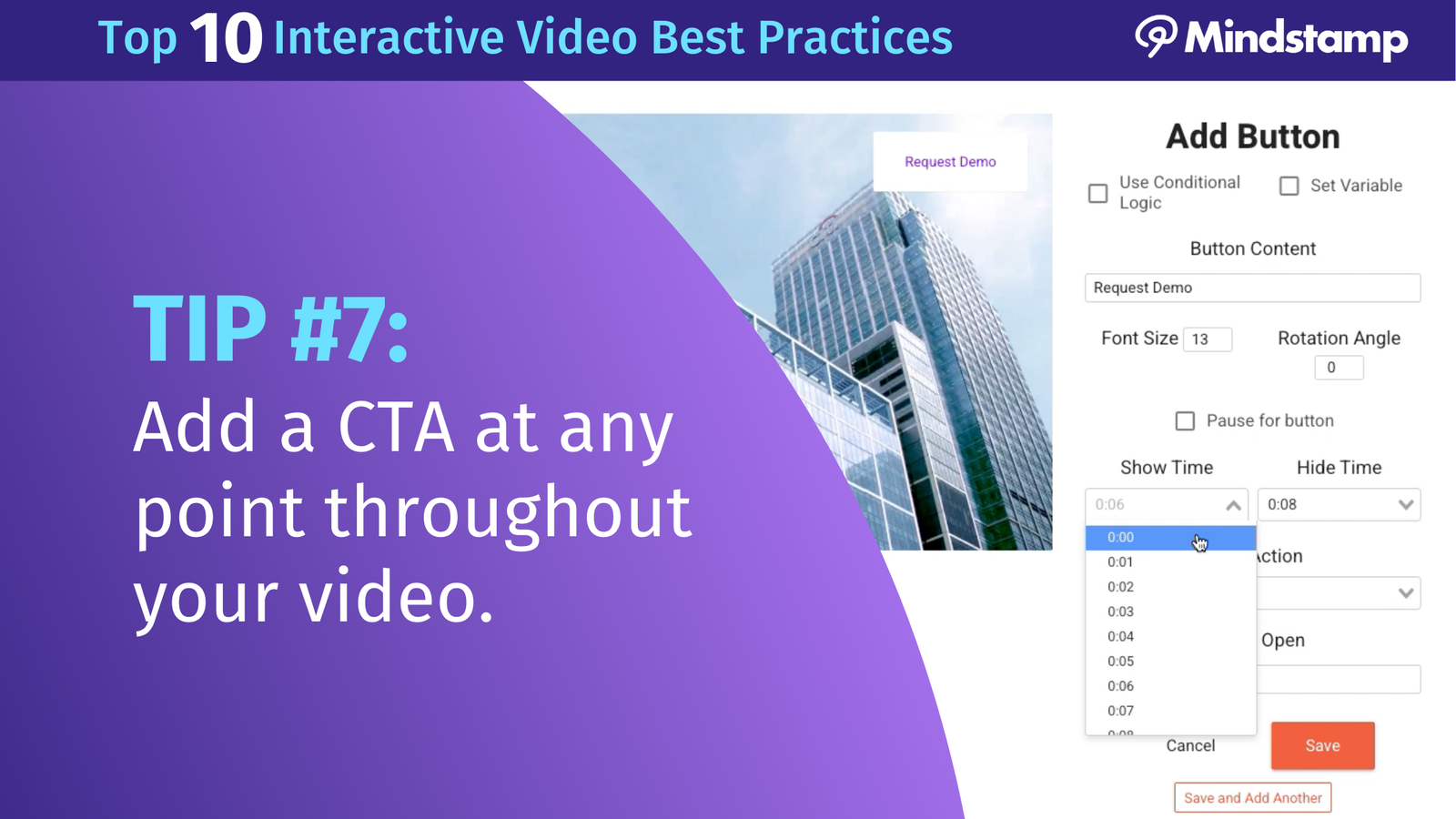
When the viewer must choose or confirm something, put the pause on the interaction itself. Open the button, hotspot, text, or image and set Pause under Timing:
- At show time, with Pause Length set to Until Interaction: the video pauses when the item appears and continues when the viewer clicks any interaction on screen.
- At show time, with 5 to 60 seconds: the video pauses for that time, then plays on.
- At hide time (Require Click): the video keeps playing while the item is on screen and pauses at its hide time only if the viewer has not clicked it.
Questions pause the video by themselves, so they need no extra pause. To point at something on a paused frame, add a drawing, which also stops the video; see how to highlight and draw on any video.
Example: an acknowledgment check
For a key message, such as a safety rule or a policy change, stop at the end of the explanation and ask the viewer to confirm it:
- Add a button that reads "I understand" with its Click Action set to Continue.
- Add a second button that reads "Show me again" with a Change Time click action back to the start of the explanation.
- On one of the buttons, set Pause to At show time with Pause Length Until Interaction.
Both clicks are recorded against the viewer, so your report shows who asked to see the section again. The viewer who chose "Show me again" meets the same two buttons at the end of the second pass.
Require several clicks
Give several items At hide time (Require Click) and the same hide time. If five hotspots show from 0:10 to 0:20, the video pauses at 0:20 until the viewer has clicked all five, and a viewer who clicks them all before 0:20 never sees a pause. Set each hotspot's Post Click State to Change Colors so viewers can see which ones are left. To stop viewers from dragging the seek bar past a required item, turn on Prevent passing required interactions under Settings > Viewer experience. The guide on requiring a click before the video continues has the details.
A paused video with no visible way forward is a dead end. Make the target easy to see, never make a hotspot with no ring the only way to continue, and test on a phone and with the keyboard before you share.
How to replay a section until the viewer gets it right
After a wrong answer, a loop can send the viewer back to the explanation and then ask again. That retry is a form of practice testing: a 2017 meta-analysis found practice tests more beneficial for learning than restudying and every other comparison condition it examined (Adesope, Trevisan, and Sundararajan, Review of Educational Research). Mindstamp gives you three ways to send a viewer back:
- Turn on Repeat Until Correct on the question. The viewer must answer correctly before moving on.
- Set the Action on each wrong answer to Change Time. The viewer goes back to the explanation as soon as they answer.
- Store the answer in a variable and show a Try again button only after a wrong answer. The viewer sees the result and chooses to review.
To build the third option:
- Add a multiple-choice question and mark the correct answer.
- In the question's Variables section, turn on Set individual variables. Give every answer the same variable, such as q1, with the value right for the correct answer and wrong for the others.
- Add a button that reads "Try again" shortly after the question, with a Change Time click action to the start of the explanation.
- In the button's Variables & Logic section, turn on Conditional Logic and set Show if q1 Equals wrong.
- Test in Preview: answer wrong, use the button, then answer right on the second pass.
When the viewer answers correctly, q1 changes to right and the button disappears. Decide what happens after several misses. You can count attempts with a variable set to Increment +1 on each wrong answer, then show a Continue button once the count is greater than 2. Every attempt is recorded in the question's report. Repeat Until Correct and answer actions need neither variables nor conditional logic. The help articles on adding a Try again button and on passing scores and retries cover the settings.
How to switch to another video and come back
Switch Video moves the viewer to another Mindstamp video. You can trigger it from three places:
- the Click Action of a button, hotspot, image, or text, or the Action on a question answer
- a Switch Video navigation that runs at a set time
- the End Screen, with Switch Video (Automatic) or Show Button: Switch Video
After you pick the destination, you can set Switch Time to start it later than 0:00, for example to skip an intro the viewer has already seen. Switch to Previous Video sends the viewer back to the video they came from, at the time they left it. It suits a short detour, such as a product demo inside a longer story. Variables the viewer set in one video travel with them to the next, so the next video can greet them by name or show only the options that fit (variables across branches).
Publish every destination. A switch to an unpublished, deleted, or restricted video does not run, and the player keeps playing the current video. Mindstamp lists unpublished destinations under Unpublished Video Branches, and the Switch Video troubleshooting guide walks through the other checks.
Change Time or Switch Video?
| Change Time | Switch Video | |
|---|---|---|
| Where the viewer goes | Another point in the same video | Another video |
| Reporting | The whole path is recorded in one view | Each video has its own view record |
| Videos in your library | No extra videos | Each branch video counts toward your plan's video total |
| Best when | All branches are sections of one file | Each path is long or reused in other videos |
For decision points, scoring, and path maps, read our guide to interactive video branching. For story-driven paths, see how to create a choose-your-own-adventure video. A chapter menu is a set of Change Time buttons, and the guide to interactive video menus shows how to keep one open to viewers for the whole video.
Test every path as a viewer
Owner playback is not what viewers see. When you play your own video, Mindstamp skips Redirect Link, Switch to Previous Video, the reset navigations, and automatic end-screen actions. It asks before a Switch Video leaves the editor, and it resets required clicks so you can test again. Test from the viewer's side instead:
- Open the share link in a private browser window where you are not signed in.
- Play from a few seconds before each jump, pause, and switch.
- Follow every path to its end, on a phone as well as a computer.
- Open the view in your reports and check that each click and each part of the path is there.
Two report fields behave differently in videos with jumps. Furthest point is the latest moment the viewer reached, and last point is where they were when the session ended, so a jump back makes them differ. Watched percentage counts unique seconds played, so repeats of a loop do not raise it. The help article on furthest point and last point explains both. Your plan's streaming minutes use the same count: each second of the video counts once per view, so a section that loops ten times in one view uses its streaming time once.
Common questions
Should a menu loop or pause?
Pause when a still frame works, such as a title card or a diagram: set the menu buttons to pause At show time, Until Interaction. Loop when the scene should keep moving behind the choice, such as a product turning on a stand or background footage behind a question.
Can I stop viewers from skipping ahead?
Yes. Turn off Allow Seeking in the video's Design settings, and turn on Prevent passing required interactions in Settings so viewers cannot seek past a question or a required click. Your own Change Time buttons, chapters, and answer actions still move the viewer, by design. See how to stop learners from skipping ahead.
Do loops and jumps work with YouTube videos?
Mindstamp accepts YouTube links for testing only. Before you publish, upload the original file or link it from a supported host such as Vimeo or Wistia, and use Replace source video so your loops, pauses, and switches stay in place (YouTube in Mindstamp).
Which plans include these controls?
Video branching, which includes Change Time and Switch Video, is on every Mindstamp plan. Variables and conditional logic, which you need to end a loop after a choice or to show a Try again button, are on supported plans. The pricing page lists each plan. Our navigation and video branching feature pages show more examples.
Start with one control in a video you already have: a loop behind a choice, an acknowledgment check after a key message, or a Try again button after one question. Test it from the share link, then read the clicks in your report a week later to see where viewers went back.