 Brett Lindenberg
Video software makes employee training engaging when it asks learners to act during the video, for example by answering a question, choosing what to say, or recording a practice answer, and when it shows you who did it. You will usually combine a screen recorder such as Loom for quick how-to clips, a video platform or LMS to deliver and track courses, and an interactive video layer such as Mindstamp for questions and branching with a report for each learner. The ten methods below show what each kind of tool contributes. Start with the short scenario below: an employee says a deadline is at risk, and you choose the supervisor's first response.
Which video software do companies use for employee training?
No public register shows which training tools each Fortune 500 company runs. Several vendors list large customers on their websites, and the table below groups their tools by the job each one does. The customer claims come from each vendor's own website, checked in October 2026. Treat them as a sign of adoption, and test fit with a trial of your own.
| Kind of tool | Job in training | Examples | What it reports |
|---|---|---|---|
| Screen and camera recorders | Software walkthroughs, process updates, quick answers | Loom, which calls itself a free screen recorder for Mac and PC | Who watched (by name only when the viewer is signed in to Loom); completion rate and call-to-action clicks on Loom's Business, Business+ AI, and Enterprise plans |
| AI avatar video generators | Presenter-led videos made from a script | Synthesia, which says it is trusted by 90% of the Fortune 100; HeyGen, which says 85% of the Fortune 100 | Built for making video; you track viewing in the tool you deliver it with |
| Enterprise video platforms | Storing, searching, and sharing recorded sessions | Microsoft Clipchamp in Microsoft 365, which stores videos in OneDrive and SharePoint; Panopto, which says it has 2,000+ customers across higher education and enterprise | Varies by platform; ask whether reports name each learner |
| Interactive video layer | Questions, choices, hotspots, and practice answers inside the video | Mindstamp | Each learner's answers, scores, and path; completion and score to an LMS through SCORM |
| LMS or learning platform | Enrollment, assignments, reminders, and transcripts | Docebo, which says 3,500+ organizations use it, from Fortune 100 companies to federal agencies | Course completion and scores by learner |
Mindstamp is not an LMS. It does not enroll learners or assign courses. You deliver its videos through your LMS with a SCORM package, an embed, or a link (Is Mindstamp an LMS?). For a vendor-by-vendor comparison of interactive training tools, see best interactive video software for corporate training.
10 ways video software makes employee training engaging
1. Ask a question at the moment you teach the point
A question in the video turns watching into recall, and recall makes learning last. In a 2006 study, Roediger and Karpicke found that students who took recall tests remembered more of a text two days and one week later than students who restudied it, even though restudying made students more confident (Psychological Science, 2006). Szpunar, Khan, and Schacter split a 21-minute video lecture into four segments of about 5.5 minutes each. Learners who answered questions after every segment reported mind wandering at 19% of attention checks, against 41% for learners who were not tested, and scored 90% on the final test against 68% (PNAS, 2013).
In Mindstamp, a question pauses the video at the timecode you choose. Put each one right after the step it tests. Turn on Repeat Until Correct so a learner who answers wrong tries again, or send a wrong answer back to the explanation with a time jump (passing scores and retries).
2. Let learners choose and see the consequence
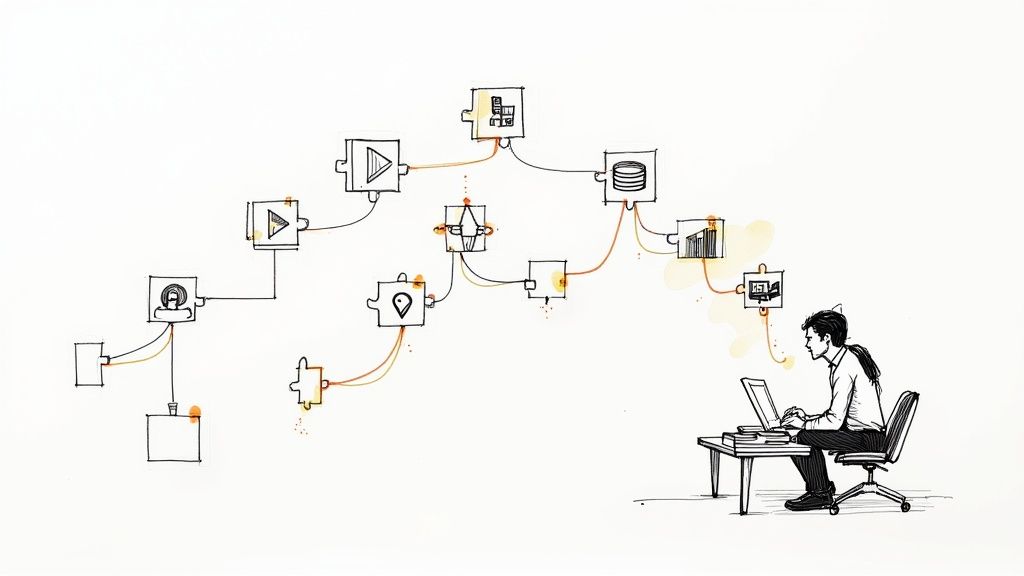
A branching scenario asks what the learner would do, then shows what happens. The demo at the top of this page works this way: three possible first responses, each with its own consequence scene. In Mindstamp, branching can jump to another time in the same video or open a different video, and the report shows the path each learner took. Build the scenario around a decision people get wrong at work. Our guide to scenario-based training covers how to write the choices and the debrief.
3. Have learners practice on camera
Some skills have to be performed, such as a sales pitch or a safety briefing. A 2014 Training Magazine article on role-play lists three benefits: it builds confidence, develops listening skills, and gives teams practice in creative problem-solving with difficult situations (Training Magazine). Video lets learners practice without booking a live session for each person. In Mindstamp, a video response question asks the learner to record an answer of up to 120 seconds in the browser, with nothing to install. Mindstamp does not score these recordings. A manager plays them back in the report (video and voice responses). Tell learners who will watch their recording and why, because a recording of a face or voice is personal data.
4. Record quick how-tos, then add a check
For software steps and process changes, a screen recorder is the fastest tool. Loom records the screen and camera from a Chrome extension, a desktop app, or a mobile app. Its reports are light for training purposes. Loom counts a view after as little as 5 seconds of watching, names a viewer only when they are signed in to Loom, and shows completion rate and call-to-action clicks on its Business, Business+ AI, and Enterprise plans (Loom help). When a recording teaches something learners must get right, download it as an MP4 and upload it to an interactive tool to add a question after each step. Mindstamp no longer imports Loom links. Loom allows downloads on its Business, Business+ AI, and Enterprise plans, not on Loom's Starter plan, which is free. See which video sources Mindstamp accepts.
5. Make equipment and screens clickable
When the video already shows the machine or the software, let learners click the part itself. A hotspot is a clickable area over an object in the frame. Use one to identify parts on a machine or controls in a software tour, and to open a link, show a short explanation, or send the learner to another scene. Each click is recorded against the learner. Place hotspots at a moment when the object is still, and check them on a phone before you publish.
6. Let experienced staff skip what they already know
One recording can be short for an experienced employee and thorough for a new one. Ask a question at the start of a section, send learners who answer correctly forward with Change Time, and send the rest into the full explanation. For long recordings such as webinars and system demos, add chapters so learners can see the structure and jump to the section they need.
7. Personalize by name and role
A video that greets the learner by name reads like it was made for them. Mindstamp fills placeholders such as {{NAME}} at play time from the link, the embed, or your data, and {{NAME|there}} shows "there" for anyone without a value. To route by role, ask for the learner's role early in the video and branch to the matching section, so a new manager and a new technician start in the same onboarding video and see different parts of it. Personalization variables are available on supported plans; see personalization.
8. Require completion where the rules demand it
For compliance training, a completion record should mean the learner watched and answered. In Mindstamp, turn off seeking so the seek bar cannot be dragged, and turn on Prevent passing required interactions so nobody moves past an unanswered question. Then turn off skipping on each question that must be answered (stop learners skipping ahead). These settings matter for LMS records. The SCORM completion checkpoint follows the playback position, so without them a learner who drags to the end can reach it without watching.
9. Report on each learner
A play count says a video was opened. A training report needs to say who watched, how they answered, and what they missed. Mindstamp records each learner's answers, scores, and path through the video. The completion report gives one row per learner with an average score and a score for each video, and raw view exports add watched percentage and a column for each answer (export training records). To join views into one learner record, identify people with an email address or an employee ID on every video. Anonymous views on two devices show up as two people (track a training course).
10. Deliver training where people already work, and keep it current
Employees seldom browse a video portal. Microsoft reported that in its retired Stream (Classic) service, 83% of page views came from direct links or videos embedded in other places, and 5% went to the portal's home page (Microsoft Learn). Put training where people already go, such as the LMS or the intranet page for the process. A Mindstamp video works as a link, an embed, or a SCORM package (SCORM 1.2, or SCORM 2004 3rd or 4th edition) for a compatible LMS. Edits you make in Mindstamp show in the LMS without a new package.
When the process changes, replace the video file, and the interactions, share link, and embed code stay in place. For a program with several parts, a playlist gives learners one link and reports progress across the set. For staff who speak other languages, translation of the interactive layer alone is free on every plan.
Which video platforms have the best analytics for tracking employee engagement?
Pick by the question you need answered. Each question below needs more detail than the one before it, and each kind of tool reaches a different depth:
| Question you need answered | What the tool must record | Example (checked October 2026) |
|---|---|---|
| Is anyone watching? | Views and viewers | Loom Viewer Insights, on every Loom plan |
| Did each person finish? | Completion by named viewer | Loom Engagement Insights, on Business plans and higher |
| Did each person understand? | Answers, scores, and choices by learner | Mindstamp reporting |
| Does the LMS show it? | Completion and score sent to the LMS | A SCORM package, such as a Mindstamp SCORM export |
Set your completion target from data. Across 8.07 million views of 18,315 Mindstamp videos (2018 to October 2026), the average view played 46.5% of the video. Videos where viewers took more than three actions per view averaged 51.8% watched, compared with 43.9% for videos where viewers took no action. Many factors differ between these videos, so treat this as a pattern, not proof. If you need everyone to finish, define completion by the questions answered and enforce it with the settings in method 8. For the wider measurement plan, see how to measure training effectiveness.
Video and employee engagement software
Employee engagement software usually means survey, feedback, and recognition platforms that measure how people feel about their work. Training video software teaches skills. The two meet in leaders' video updates, which belong to internal communications, and in training that employees see as a chance to grow. SHRM's toolkit How to Develop and Sustain Employee Engagement (updated August 2024) covers the HR side. For the video side, see our guides to internal communications video and employee engagement best practices for training.
Common questions
Is Loom good for employee training?
Loom is good for fast recordings, such as a software walkthrough or a process change you would otherwise type out. For records, see the limits in method 4: names appear only for signed-in viewers, and completion rates need a Business plan or higher. For content that learners must understand, add questions in a tool that records answers per learner, and deliver it through your LMS if you need completion records there.
What is the best video tool for employee upskilling?
Pick by the skill. For software and process skills, use a screen recording with a question after each step. For judgment and conversations, use a branching scenario and video response practice. For skills that depend on space, such as finding hazards on a site, a 360 tour or VR may be worth the cost. Mindstamp has no 360 or VR support, so you would build those in another tool; see how VR video production and interactive video fit together, including PwC's break-even figures. Test any tool with one real course before you buy.
How do I know whether video training is working?
Start with the questions inside the video: the ones most learners miss show what to reteach. Then look past the video at the task you trained, such as error rates, support tickets, or audit findings. Our guide to measuring training effectiveness walks through the levels.
Start with one video
Pick one training video your team already uses. Add a question after each key step and one branching decision, then send it to a small group. Read the report after a week: the answers tell you what to fix before you build anything new. For planning and filming the videos themselves, see our guide to employee training videos, and for more on running training with Mindstamp, see interactive video for training.
Sources and further reading
An earlier version of this article was a guest post by Matthew Gatchalian of Finances Online. This link from that version covers market data:
- GlobeNewswire: The Insight Partners' 2022 video editing software market forecast, which valued the market at $1.94 billion in 2019 and projected $3.04 billion by 2027